A thrift-store find can look like a small project until you start counting everything it needs. A repair-or-pass checklist helps you see the whole commitment before the appealing price or unusual shape takes over.
Build the checklist around your intended use, your limits, and the uncertainties you can resolve. You are deciding whether this particular piece belongs in your life, not proving that every old object deserves the same restoration effort.
Write the job before judging the object
Describe what you need in one sentence: a working bedside drawer, a dining chair for daily use, or a cabinet that can wait while you arrange professional work. That sentence gives the inspection a practical destination.
A display piece and a chair that must support a person have different consequences if a repair fails. Do not let a low price make you treat a load-bearing problem as a purely cosmetic experiment.
Next, list your non-negotiables, such as available floor space, collection access, a maximum total budget, and a realistic project window. Include where the piece will wait while you work on it.
If you do not have somewhere to keep an unfinished project out of daily traffic, record that constraint now. A beautiful cabinet can become an expensive obstacle when its doors cannot open without blocking your room.
Use four separate inspection boxes
Give structure, operation, surface, and completeness their own spaces on the sheet. Separating them prevents one attractive feature from masking a problem in a different category.
Under structure, note visible movement, cracks, missing supports, and earlier repairs. You do not need to diagnose every defect at the shop; you need to recognize which observations require an informed opinion before normal use.
Under operation, record what opens, closes, latches, and adjusts as intended. Describe a drawer that rubs at its right front corner rather than calling the whole cabinet sticky.
Under surface, distinguish acceptable wear from lifting material, missing wood, unknown coatings, and damage you cannot identify. Under completeness, count handles, fittings, shelves, feet, and other necessary parts.
Make uncertainty visible
Add an unknown box beside each observation. A dark mark may have several causes, and an unfamiliar connector may be intact even when you cannot identify it.
Write what you would need to resolve the question: a maker label, the assembly instructions, a photograph of the underside, or a repairer’s estimate. This turns uncertainty into a concrete next step.
Give each unknown a consequence. If the answer would only change a decorative preference, it may not matter much; if it determines whether the piece can be used safely, it needs attention before purchase or use.
Do not assign a confident low repair cost to an unidentified problem. An honest range or a pending estimate is more useful than a precise number that came from optimism.
Decide what you can reasonably do
List the tasks you understand well enough to plan, along with the tools and space they need. Keep those tasks separate from work that would require new skills, specialist equipment, or professional help.
A missing ordinary knob may be manageable once you know the mounting dimensions. A damaged traditional joint or unusual historic finish can involve decisions you should not improvise from a short online tutorial.
Consider whether your proposed repair would remove original material or obscure useful construction evidence. For a potentially valuable antique or sentimental object, a conservator’s advice can change the sensible scope of the project.
You do not have to acquire every skill through a purchase. Sometimes the best learning project is a simpler, less consequential object that lets you practice without risking the piece you actually want to keep.
Budget the whole route to usefulness
Make separate lines for purchase, transport, parts, consumables, outside work, and disposal or onward handling if the project changes. A cheap dresser that needs paid collection is not the same purchase as a small stool you can carry comfortably.
Include supplies you will need only because of this project. Reusing an existing tool is different from buying a tool, storage for it, and the extra materials required to learn how to use it.
Give your time a practical description instead of pretending to know an exact hourly cost. “Requires two clear weekends and a place to dry” tells you more than a hopeful estimate made during a lunch break.
Keep a reserve for a real uncertainty rather than treating every unspent dollar as available for cosmetic upgrades. If a necessary estimate is missing, the total remains provisional.


Try three different decisions
Imagine a small cabinet with sound construction, functioning doors, and a surface you already like. One missing pull with confirmed mounting dimensions might leave you with a clear, bounded project.
Now imagine a chair with a moving leg joint and an old metal brace. Its pretty finish does not tell you whether the repair underneath is appropriate, so an experienced assessment belongs before any decision about everyday seating.
Finally, imagine a large wardrobe that is complete but will not pass through your stair landing without dismantling. If you cannot confirm that it is designed to come apart, the access problem may be enough to pass regardless of condition.
These examples do not establish a universal rule about furniture types. They show how your checklist can connect a particular observation to a specific consequence.
Keep sentiment and constraints on the same page
It is reasonable to value a distinctive piece beyond its resale price. Write that value down honestly rather than disguising a personal preference as a prediction that the repair will be easy.
If the shape, history, or connection matters to you, consider a slower professional project with an agreed budget. The important point is that you have chosen that commitment deliberately.
For an ordinary replaceable item, compare the finished total with alternatives that already work. Include whether those alternatives actually fit your room and needs rather than comparing only sticker prices.
A pass is not a judgment that the object has no value. It can simply mean that this project needs a different owner, workspace, skill set, or point in your life.
Choose an action you can explain
Finish the sheet with buy, ask for information, request an estimate, or pass. Avoid a vague maybe that depends on several unresolved problems somehow becoming minor after you get home.
If you ask for more information, specify the exact photograph, dimension, or label you need. A focused request is easier for a seller to answer than an open-ended question about whether restoration will be difficult.
Take a dated photograph of your completed checklist and the furniture. The record helps you retain the reasons for your decision when another attractive listing appears a few days later.
You have a useful checklist when it makes your next action clear. It should help you choose a manageable piece, recognize a worthwhile professional project, or walk away without feeling that a low price obligated you to take it home.
Avoid a misleading total score
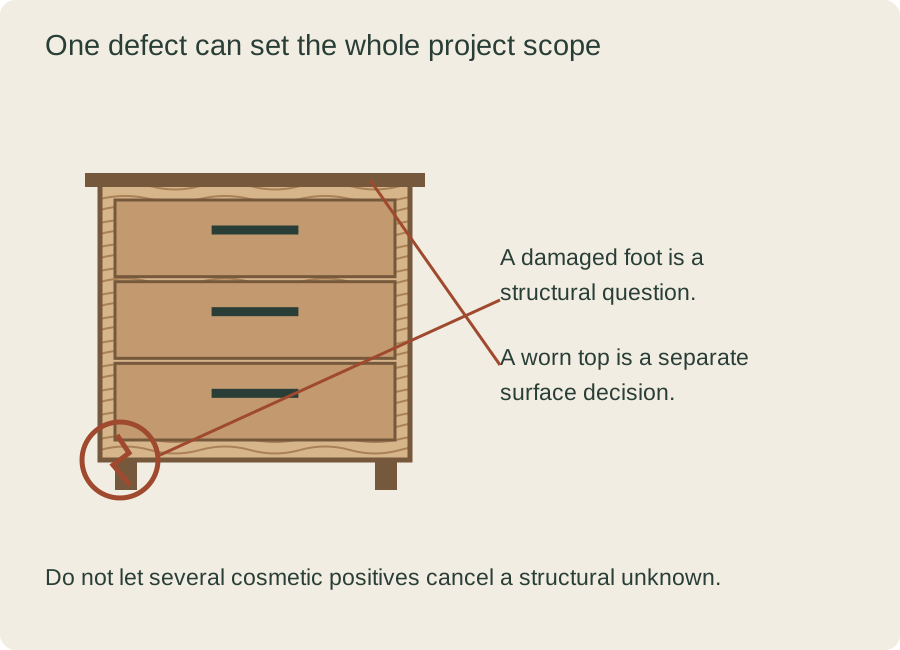
You can use simple labels such as clear, needs work, and unresolved, but avoid adding them into a single numerical score. A harmless finish mark should not mathematically offset a major structural uncertainty.
Give any essential condition its own decision gate. For instance, an unresolved collection route or a missing safety-critical component should remain visible even if every decorative feature meets your preferences.
When someone else helps with the decision, show them the observations before your preferred conclusion. A second person can notice the missing estimate or awkward storage requirement that you have started to overlook because you like the piece.
Sources & editorial notes
Research checked October 22, 2026. Practical examples are editorial explanations; no personal restoration experience or product testing is claimed.
Your next useful step
01 / How to Check a Used Wood Dresser Before You Bring It Home →02 / How to Photograph Furniture Damage Before Starting a Repair →03 / How to Keep a Furniture Repair Log That Helps Next Time →