Best 0-100/200 Psi Pressure Gauges for at-Home and Industrial Use
Looking for a reliable gauge to monitor liquid or gas pressure within a 0–100 to 0–200 psi range? This guide selects five dependable options from Amazon that cover common tasks like water pumps, air compressors, and refrigeration systems. Each product is described with who it’s best for, why it’s a good fit, and a practical caveat. Use the buyer-friendly notes to compare features at a glance and choose the gauge that matches your setup and maintenance needs.
| Product | Best For | Key Benefit |
|---|---|---|
| SENCTRL 0-100 Psi Liquid Filled Low Pressure Gauge | Home workshops, small water systems | Glycerin-filled for stable readings |
| MEASUREMAN 0-100 psi / kPa | Industrial and domestic uses needing dual scale | 2.5″ dial, robust stainless steel |
| SENCTRL 0-200 Psi Liquid Filled Gauge | Medium-range applications, water/oil tests | Wide range in a durable case |
| SENCTRL 0-160 Psi Liquid Filled Air Gauge | Portable air compressors, pumps | Solid for air systems with liquid-filled protection |
| BPSSDI 0-60 Psi Glycerin Filled Low Pressure Gauge | Refrigeration and small systems | Compact 2.5″ dial with glycerin fill |
SENCTRL 0-100 Psi Liquid Filled Low Pressure Gauge

Best for: small water systems, pool equipment, and basic testing rigs. This gauge uses brass and stainless wetted parts for non-corrosive liquids and some gases. The glycerin fill minimizes pointer flutter and dampens vibration, improving readability. The 0–100 psi scale is paired with a 304 stainless steel case for corrosion resistance. Notable: accuracy is ±3% across the range, which is suitable for routine checks but not high-precision lab work.
MEASUREMAN Pressure Gauge 0-100 psi/kPa
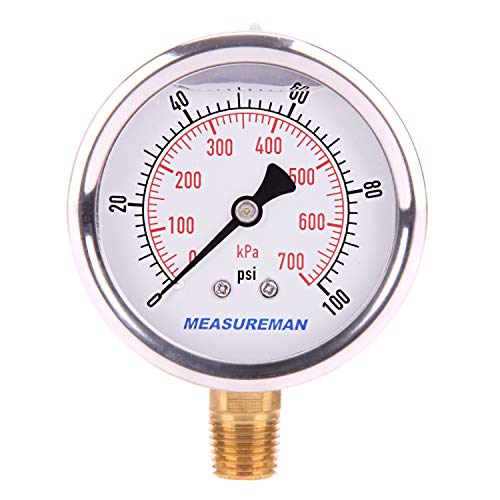
Best for: both industrial and domestic setups needing a clear dual-scale readout. Features include a 2.5-inch dial for easy visibility and a 304 stainless steel case to resist corrosion. Glycerin filling reduces vibration effects, offering steadier measurements under pulsating flow. The formula reads 0–100 psi and 0–700 kPa, but users should monitor for potential parallax errors on off-angle views in bright environments.
SENCTRL 0-200 Psi Liquid Filled Gauge

Best for: medium-range projects such as air compressors, water systems, and hydraulic checks. This gauge shares the same durable construction as the 0–100 model, with a broader 0–200 psi range and a corrosion-resistant 304 stainless steel case. Glycerin filling helps with smoother indications during pulsation. Limitations: the wider range can reduce minor measurement sensitivity in very stable systems, so use in conjunction with other indicators for critical processes.
SENCTRL 0-160 Psi Liquid Filled Air Gauge
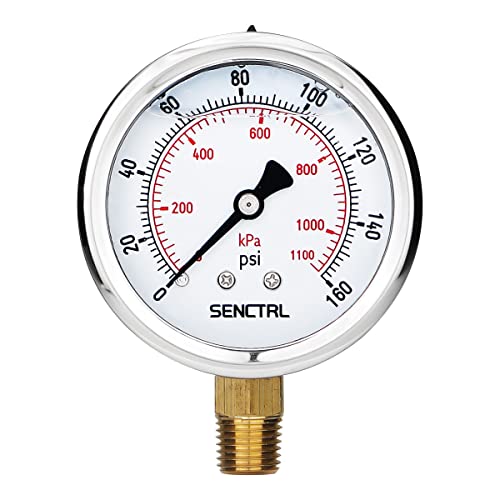
Best for: portable air systems, pumps, and quick checks on tanks or pipes. It features a 0–160 psi scale with glycerin filling to cut down on pointer flutter and bounce, while the 304 stainless steel casing provides corrosion resistance. A caution: ensure air-only compatibility when using with liquids, as the presence of liquids can affect readings in certain setups. The product is suitable for general air-testing tasks and small-scale pneumatic work.
BPSSDI 0-60 Psi Glycerin Filled Low Pressure Gauge

Best for: refrigeration systems, evaporators, and small testing rigs needing a compact, low-range gauge. The 2.5-inch dial is easy to read, and glycerin filling reduces flutter and protects internal mechanisms from vibration. The brass and stainless wetted parts extend compatibility with non-corrosive liquids and gases. Caution: at the lower end of the range, accuracy can be more sensitive to installation orientation and thermal expansion in some environments.
Buying Guide: Key Purchase Considerations
- Measurement Range: Choose a gauge with a range that matches your system’s typical pressures. A gauge that’s too small a range may saturate quickly; one that’s too large may reduce resolution.
- Wetted Parts: Brass and stainless steel components resist corrosion for non-corrosive liquids and gases. For corrosive media, verify compatibility before purchase.
- Dial Size and Mounting: Larger dials (2.5″ or more) offer easier reading from a distance. Lower, back, or inline mounting options fit different installation constraints.
- Fill Type: Glycerin-filled gauges dampen pointer flutter caused by pulsation or vibration, improving stability in noisy systems. Liquid-filled gauges can be heavier and slightly slower to respond to rapid changes.
- Accuracy: Typical accuracy of ±3% across the range is common for general purpose gauges. For precision tasks, look for tighter specifications or calibration options.
- Ingress Protection: For outdoor or damp environments, consider models with corrosion-resistant housings and protective seals to minimize fogging and condensation.
- Dual-Scale Readouts: PSI and kPa dual scales are helpful for international or mixed-unit settings and facilitate quick cross-checks.
- Maintenance: Regular inspection for leaks, vibration damage, and gasket wear extends gauge life. Accessibility for calibration is a plus in complex systems.
Frequently Asked Questions
- What does glycerin-filled mean for a pressure gauge?
– It means the gauge is filled with glycerin to dampen the movement of the pointer, reducing flutter from pulsation and vibration, which improves readability over time. - Are 0-100 psi gauges suitable for water pumps?
– Yes, many 0-100 psi gauges are designed for water systems, wells, and pumps, offering reliable readings in domestic and light industrial setups. - Is a dual-scale psi/kPa gauge better than a single-scale gauge?
– Dual-scale gauges are versatile for users who work with different unit systems or need quick cross-checks without conversion. - What should I watch for when mounting a 2.5-inch dial gauge?
– Ensure a secure, vibration-free mount and that the gauge is oriented so reading is easy from the usual viewing angle to avoid parallax errors. - Can I use an air gauge for liquids?
– It depends on the media and the gauge design. Some liquid applications require gauges with specific wetted parts and seals suitable for liquids; verify compatibility before use. - Do these gauges require regular calibration?
– Regular calibration is recommended for critical systems, especially in industrial settings, to maintain accuracy within specified limits.