Best 3 Circular Saw Blades for Wood, Plastic, and More
The best 3-inch circular saw blades deliver clean, precise cuts across wood, plastic, and other soft materials. This guide identifies top options, explains who each blade is best for, and helps you compare features like tooth count, arbor size, and kerf. Ideal buyers include DIY enthusiasts, hobbyists, and professionals who need compact blades for quick, accurate cuts in tight spaces.
Summary of selected products:
| Product | Tooth Count | Arbor | |
|---|---|---|---|
| FOXBC 3 Inch 80T 5 Pack | 80T | 3/8″ | 5 Pack |
| Revvstark 3 Pcs 36T | 36T | 7/16″ (11.1 mm) / Bushing 3/8″ | 3 Pack |
| Ryltanks 4-Pack 80T & 36T | 80T and 36T | 3/8″ | 4 Pack |
| FOXBC 3 Inch 36T Carbide 3 Pack | 36T | 7/16″ | 3 Pack |
| Seesii 24T & 36T 2-Pack | 24T & 36T | 3/8″ | 2 Pack |
FOXBC 3 Inch 80T Circular Saw Blade – 5 Pack

Best for high-volume cutting tasks where speed and clean edges matter. The 80-tooth count enables smoother finishes on plywood, OSB, veneer, and similar materials. This 3/8″ arbor blade is compatible with a range of compact tools, including Dremel Ultra-Saws, Ridgid 18V models, Milwaukee 2522-20, Ryobi One+, Dewalt 20V, and Worx. Choose this if you frequently cut thin sheets and want very smooth surfaces. Caution: higher tooth counts can be slower on very hard materials.
Revvstark 3 Pcs 36T Circular Saw Blades
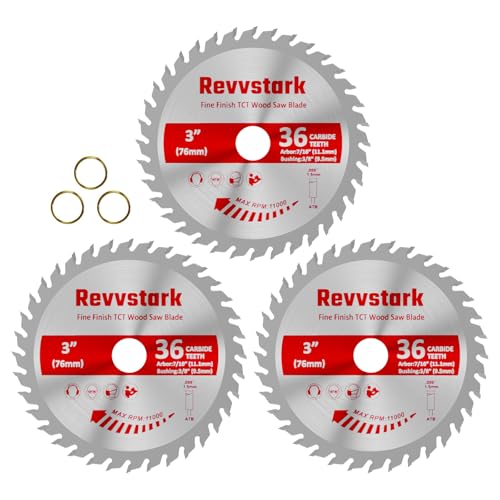
Best for versatile, everyday wood cutting with a balance of speed and finish. The 36T blades use durable carbide teeth for wear resistance and heat tolerance, supporting true cuts at high RPMs (up to 11,000). They’re well-suited for plywood, softwood, and panels. Choose these if you want a reliable set for general carpentry and quick rough-and-finish work. Limitation: 36T blades may wear faster on dense hardwoods compared to higher-tooth blades.
Ryltanks 4-Pack 3/8 Inch Arbor 3 Inch Blades

Best for budget-conscious buyers who need multiple blades for different jobs. This set includes both 80T and 36T options, allowing users to switch between fast, clean ripping and faster rough cuts. The 3/8″ arbor ensures broad tool compatibility with common compact saws. Choose this if you want a mix of tooth counts in a single purchase. Caution: check compatibility if your saw uses a nonstandard arbor size.
FOXBC 3 Inch 36T Carbide Blade – 3 Pack

Best for precise detail cuts where a finer finish is needed. The 36T carbide teeth deliver smooth cuts in wood, plastic, PVC, acrylic, and aluminum, with a 7/16″ arbor option. This pack is ideal for hobbyists who want a compact blade for quick setup and multiple small projects. Limitation: lower tooth count means rougher cuts on dense hardwoods or very thick panels.
Seesii 3″ Carbide Blades – 24T & 36T

Best for a two-blade setup that covers rough and finish cuts. The 24T blade excels in faster, lighter cuts, while the 36T blade yields smoother finishes. The 3/8″ arbor ensures broad compatibility with most 3″ saws. Choose Seesii if you want a simple, two-tooth-count pairing in one package. Limitation: the dual-blade system may require frequent blade changes for mixed-material projects.
Buying Guide: Key Considerations For 3-Inch Circular Saw Blades
- Tooth count and cut quality: Higher tooth counts (like 80T) produce smoother finishes on plywood and veneer but cut slower through thicker or harder materials. Lower tooth counts (24T–36T) cut faster but leave rougher edges.
- Arbor size and compatibility: Most 3″ blades use 3/8″ or 7/16″ arbors. Verify your tool’s arbor size and bushing compatibility to avoid slippage or poor seating.
- Material and carbide type: Carbide-tipped and tungsten carbide blades offer longer life and better wear resistance for wood, plastics, and soft metals. Diamond blades are not typical for 3″ wood blades but may appear in mixed-material sets.
- Kerf thickness and cut speed: Ultra-thin kerfs reduce resistance and require less power, enabling cleaner and faster cuts with less material waste.
- Purpose of use: For cabinet work and finish carpentry, favor higher tooth counts. For rough-cutting or framing in soft materials, choose lower tooth counts.
- Compatibility with tool brands: Some blades are advertised as compatible with multiple brands. Check for any required adaptors, bushings, or shims for your specific saw model.
Frequently Asked Questions
- Q: Can I use 3-inch blades on a standard contractor saw? A: Most 3″ blades are designed for compact or mini saws with compatible arbors; check your tool’s manual for blade size compatibility.
- Q: Are carbide blades worth the extra cost? A: Carbide-tipped blades last longer, resist wear, and provide consistent performance on varied materials, justifying the investment for frequent use.
- Q: What’s the best blade for plywood? A: An 80T or 70–80T carbide blade delivers the smoothest finish on plywood and veneer; lower T count blades cut faster but rougher.
- Q: How do I choose between 24T, 36T, and 80T? A: 24T is fastest for rough cuts; 36T balances speed and finish; 80T offers the finest finish for light materials.
- Q: Are there safety concerns when switching blades? A: Always unplug the tool, clamp the workpiece, wear eye protection, and follow the blade manufacturer’s installation instructions.
- Q: Do these blades suit plastic and aluminum cutting? A: Some blades advertise compatibility with plastic and soft metals; verify the blade’s material recommendations and manufacturer guidance.