Best 8 1/4 Saw Blades for Precision and Longevity
Looking for a reliable 8 1/4 inch saw blade for framing, fine finish work, or general woodcutting? This guide highlights five top options, each chosen for durability, cutting accuracy, and wide compatibility. Best for professionals needing clean finishes, best for hobbyist projects seeking value, and best for mixed-use jobs. The summary table below helps you compare core traits at a glance.
| Product | Tooth Count | Kerf | Arbor | |
|---|---|---|---|---|
| DEWALT Circular Saw Blade | 24 | Standard | 5/8 inch | Framing, ripping, general purpose |
| Diablo Fine Finish Saw Blade | 60 | Thin kerf | 5/8 inch | Fine finish cuts, smooth edges |
| ANGELSWORD Table/Circular Blade | 24/40/60 | Thin kerf | 5/8 inch | Versatile for multiple cut types |
| WEN 60-Tooth Fine-Finish Blade | 60 | Ultra-thin kerf | 5/8 inch | Fine finish with softwood/hardwood |
| TOYAKI 80-Tooth Ultra-Fine | 80 | Thin kerf | 5/8 inch | Extreme finish quality, miter and precision cuts |
Note: All blades listed support common 8 1/4 inch saw configurations and 5/8-inch arbors. When choosing, consider the kerf, tooth count, and finish quality to align with your project needs and tool compatibility.
DEWALT 8 1/4 Inch 24-Tooth Framing & Ripping Blade

Product highlights include a patent-pending toughtrack tooth design that maintains accurate tracking over the blade’s life, a tungsten carbide composition for durability, and a tough coat anti-stick coating to reduce friction and gumming. Best for heavy ripping and framing tasks where long blade life and predictable tracking matter most. Caution: designed for aggressive cutting; ensure proper alignment and feed rate to avoid overheating.
Diablo Fine Finish 8 1/4″ Blade with 60 ATB Teeth
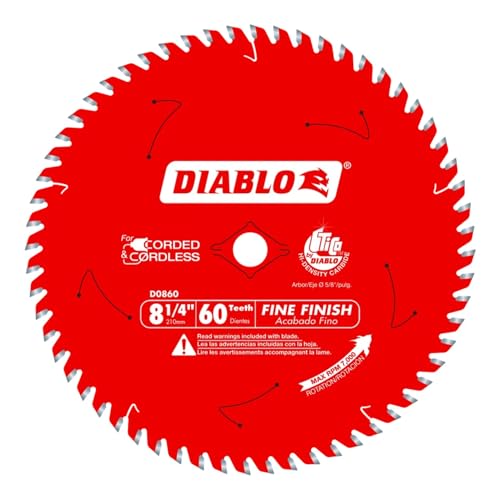
Diablo’s TiCo Hi-Density carbide teeth deliver precise, chip-free cuts with longer life in demanding fine finish applications. The Hi-ATB tooth grind ensures smooth rips and crosscuts across woods like oak and pine, while Perma-Shield non-stick coating protects against heat and gumming. Best for projects requiring ultra-clean edges. Better for finishes; avoid if you need aggressive, fast material removal on thick stock.
ANGELSWORD 24T/40T/60T 8-1/4-Inch Blade Pack
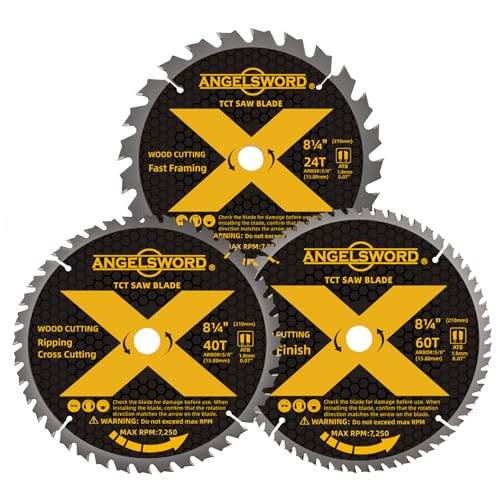
This 3-pack includes 24T for framing, 40T for ripping, and 60T for fine finish tasks. It features a 5/8″ arbor and a thin kerf designed for fast, clean cuts with durable tungsten carbide teeth. Best for users who want one blade set covering multiple cutting scenarios. Choose this when you need flexibility; caution: blade set quality may vary between varieties.
WEN 8.25-Inch 60-Tooth Fine-Finish Blade

WEN’s blade offers a 8.25-inch diameter, 5/8-inch arbor, and a 6500 RPM rating, with an ultra-thin kerf for clean, efficient cuts in both hard and softwoods. Best for finish work and precise crosscuts, while still offering enough versatility for general plywood and softwood projects. Limitation: productivity depends on machine speed and the quality of material being cut.
TOYAKI 80-Tooth Ultra-Fine Finish Blade
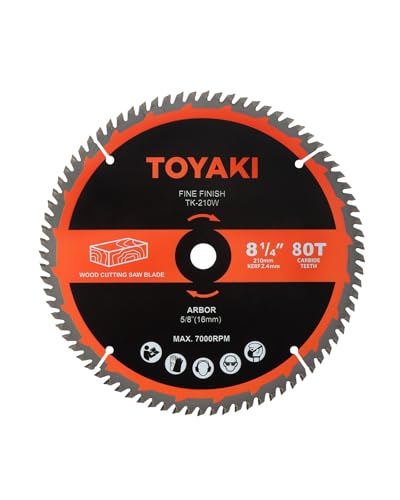
TOYAKI offers premium ultra-sharp carbide teeth for superior precision and a smooth finish. The 80 tooth count and 5/8-inch arbor suit miter saws, table saws, and circular saws, with a balanced 8.25-inch diameter and 2.4mm thickness for stable cuts. Best for fine finish work and small-detailed cuts. Better for finish quality; may cut slower through heavy stock than lower-tooth blades.
Buying Guide
What matters most when choosing an 8 1/4 inch blade?
- Tooth count and cut type: Higher tooth counts yield smoother finishes, while lower counts cut faster and handle framing tasks more efficiently.
- Kerf thickness: Ultra-thin kerfs reduce material loss and require less power, but can be more prone to deflection on hard stock.
- Arbor compatibility: Ensure a 5/8 inch arbor matches your saw’s spindle.
- Material and coating: Tungsten carbide teeth and non-stick coatings extend blade life and reduce gumming on sticky materials.
- Intended use: Framing, ripping, or fine finish will guide blade selection; some blades excel in multi-purpose roles, others are optimized for one task.
Frequently Asked Questions
- Q: Can I use a 60-tooth blade for framing work? A: It’s possible, but a higher tooth count blade may cut slower and wear differently under heavy ripping. Use a blade designed for framing for best results.
- Q: What is kerf and why does it matter? A: Kerf is the material width removed by the blade. A thinner kerf preserves more wood and reduces drag, improving efficiency on smaller saws.
- Q: Is a non-stick coating important? A: Yes, it helps prevent gum buildup and heat damage, extending blade life in difficult materials.
- Q: How do I choose between ATB and other tooth geometries? A: ATB (Alternate Top Bevel) is common for crosscuts and finishes; ATB typically yields smoother cuts in woods like oak and pine.
- Q: Should I buy a blade pack or single blade? A: Packs offer versatility for different tasks and budgets, but confirm that all blades share compatible arbor size and kerf for your tools.
- Q: How can I extend blade life? A: Use blade-cleaning as needed, maintain proper feed rate, and avoid overheating by allowing cool-down periods on dense stock.