Best Aluminum Floor Jacks for Efficient Vehicle Lifting
Aluminum floor jacks blend lightness with strength, delivering high lifting capacity while easing transport and positioning. In American garages, these tools help you swap tires, inspect brakes, and perform routine maintenance with less effort than heavier steel models. This guide highlights five top aluminum floor jacks, chosen for capacity, lift range, and durability. Each model balances portability, speed, and safety, making them suitable for DIY enthusiasts and professional shops alike.
| Product | Brand | Capacity | Lift Range | Weight (lb) |
|---|---|---|---|---|
| Jack Boss 3 Ton Low Profile Floor Jack | Jack Boss | 6600 lbs | 3-15/16″ to 18-5/16″ | 58.5 |
| ARCAN 3-Ton Quick Rise Aluminum Floor Jack | ARCAN | 6000 lbs | — | — |
| VEVOR 3 Ton Low Profile Floor Jack | VEVOR | 6600 lbs | 3-6/11″ to 19-11/16″ | — |
| JEGS Professional Low-Profile 3-Ton Aluminum Floor Jack | JEGS | 6600 lbs | 3 1/2″ to 19 1/4″ | — |
| YELLOW JACKET 3 Ton Floor Jack | YELLOW JACKET | 6600 lbs | 3.75″ to 18.9″ | — |
Jack Boss 3 Ton Low Profile Floor Jack

The Jack Boss model delivers a 6,600-lb capacity with a notably low minimum height of 3-15/16 inches and a maximum lift of 18-5/16 inches. Its low-profile design enables clearance under many modern sedans and light trucks, while a dual-piston pump accelerates lifting. A large rubber saddle protects the vehicle’s pinch welds and undercarriage during use. With a weight around 58.5 pounds, it pairs solid stability with manageable portability. The kit includes a rubber saddle and a two-piece handle for straightforward setup and operation.
ARCAN 3-Ton Quick Rise Aluminum Floor Jack

ARCAN’s 3-ton floor jack emphasizes lightweight construction through aircraft-grade aluminum, enhancing maneuverability without sacrificing lifting power (up to 6,000 lbs). The jack features dual pump pistons, allowing the saddle to rise quickly to the load point. This setup supports efficient tire changes and maintenance tasks on a variety of vehicles. The design prioritizes ease of positioning and stability, making it a practical choice for both professional shops and home garages where space and frequent use matter.
VEVOR 3 Ton Low Profile Floor Jack

VEVOR’s 3-ton low-profile jack uses a combined aluminum and steel build for a strong yet lighter tool. It offers a minimum height of 3-6/11 inches and a maximum height of 19-11/16 inches, with a dual parallel pump system to accelerate lifting across multiple strokes. Four wheels enhance stability and maneuverability, and the armrests on both sides assist in positioning the jack under a vehicle. This model is designed for versatile use, suitable for family cars, SUVs, and light trucks in both home garages and professional settings.
JEGS Professional Low-Profile 3-Ton Aluminum Floor Jack
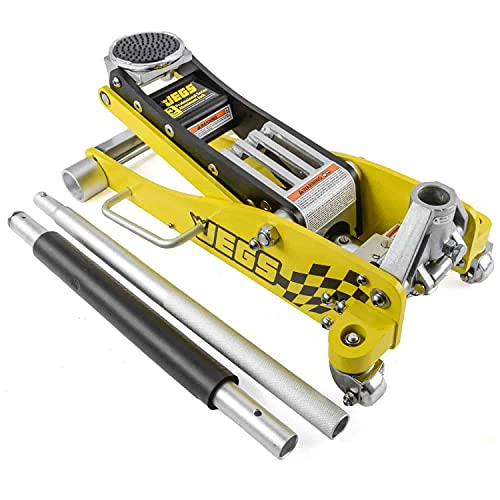
The JEGS floor jack emphasizes lightweight aluminum construction with a low-profile saddle height of 3.5 inches. It lifts from 3.5 inches up to 19 1/4 inches, enabling access under many low-clearance vehicles. A 360-degree rotating saddle simplifies positioning in tight spaces and angled approaches. This design supports easy rolling and maneuverability, making it suitable for professional mechanics and serious DIYers who require precise alignment under the chassis and wheels.
YELLOW JACKET 3 Ton Floor Jack

Yellow Jacket’s all-aluminum 3-ton floor jack combines durability with portability, framing a 6,600-lb capacity. It features a minimum height of about 3.75 inches and a maximum height of around 18.9 inches, providing access under most family cars, SUVs, and light trucks. A dual-piston pump system enables faster lifting, and an anti-slip handle design improves control during operation. The model also emphasizes vehicle protection with a large saddle and bumper considerations, aligning with ASME safety expectations for everyday garage use.
Buying Guide
- Capacity and lift range: Choose a jack with a capacity well beyond the weight of your typical vehicle, and a lift range that clears the car’s undercarriage when tires need changing or brakes inspected. Note min and max heights to fit your garage clearance.
- Low-profile design: If you work on sedans or vehicles with low ground clearance, a low minimum saddle height is essential. Compare models offering as close to 3.5 inches or lower as possible for easier racking and positioning.
- Pump system and lifting speed: Dual-piston or twin-pump designs generally rise faster and provide smoother control, saving time during routine maintenance and emergency tire changes.
- Materials and weight: All-aluminum constructions are lighter and easier to maneuver, but many models use a steel-reinforced aluminum blend to balance durability and weight. Consider how often you’ll move the jack around the garage or transport it in a vehicle.
- Stability and safety features: Look for a wide base, nonslip saddle, and protective bumpers to minimize vehicle damage. Some models include overload protection or ASME-compliant safety measures for peace of mind during lifts.
- Wheels and maneuverability: Four-wheel systems and swiveling casters improve turning and positioning in tight spaces, especially in cluttered garages or professional shops.
- Accessories and warranty: Check what comes in the box (saddle, handles, jack stands in kits) and review warranty terms. A longer warranty can indicate overall product reliability.
- Maintenance and care: Regularly inspect hydraulic components for leaks, keep the saddle clean, and store the jack in a dry area to prevent corrosion and hydraulic seal damage.
- Intended use: If you frequently work on various vehicle types (sedans, SUVs, trucks), consider a jack with a broader lift range and robust construction that handles higher vehicles without compromising speed or safety.