Best Angle Finder Tool for Accurate Woodworking and DIY Projects
Finding the right angle quickly is essential for precise cuts, clean joints, and efficient workflows in woodworking, construction, and DIY projects. This guide spotlights five top angle finder tools that pair digital precision with durable builds and easy readability. Whether you need a compact 7-inch protractor or a versatile 3-in-1 digital angle finder, these tools cover common angles and crown molding tasks. The quick-reference table below helps you compare core highlights at a glance.
| Product | Brand | Highlights |
|---|---|---|
| Klein Tools 935DAG | KLEIN TOOLS | 0–90/0–180, Magnetic base, Auto-rotate |
| Klein Tools 935DAF | KLEIN TOOLS | 3-in-1, Inside/outside, Miter saw |
| LEXIVON LX-230 | LEXIVON | 7-inch, Aluminum, Laser scales |
| Saker Miter Saw Protractor | Saker | 7-inch, Aluminum, Easy read |
| TBVHOMM Digital Angle Finder Protractor | TBVHOMM | 7-inch, 0–999.9°, Batteries included |
Klein Tools 935DAG Digital Angle Gauge

The Klein Tools 935DAG Digital Electronic Level and Angle Gauge is built for professionals who require both angle readings and a reliable level. It offers a dual-angle capability with 0–90° and 0–180° measurement ranges, plus a zero calibration feature to compare angles relative to a reference. The display is designed for high visibility and automatically rotates to stay readable whether the device is upright or inverted. A strong magnetic base enables hands-free operation on ferromagnetic surfaces like pipes, ductwork, or saw benches, improving workflow efficiency in tight spaces.
- 0–90° and 0–180° range
- Zero calibration for relative angles
- High-visibility, auto-rotating display
- Magnetic base for hands-free use
Klein Tools 935DAF Digital Angle Finder

The Klein Tools 935DAF Digital Angle Finder provides precision with a versatile three-in-one setup designed for inside and outside angle measurements and easy miter saw angle calculation. It helps carpenters and remodelers quickly determine the exact blade angle for precise miters and joint alignment. The unit emphasizes reliability with machined ruler edges that yield highly accurate readings, typically to around +/- 0.2 degrees, making it suitable for tasks where small angle deviations matter.
- 3-in-1 digital angle finder
- Inside/outside angle measurement
- Miter saw angle calculation
- Machined ruler edges for +/- 0.2° precision
LEXIVON LX-230 Aluminum Miter Saw Protractor
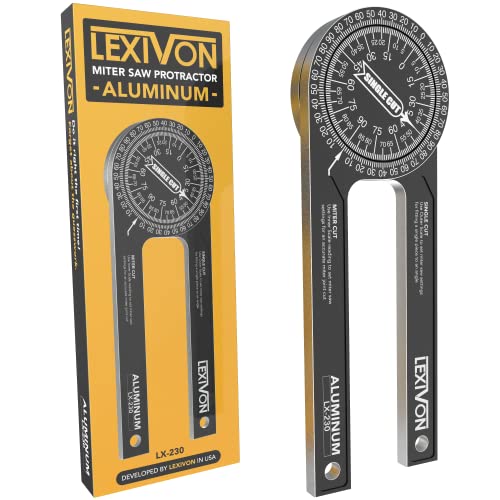
The LEXIVON LX-230 offers a robust 7-inch aluminum miter saw protractor built for demanding shop environments. CNC-machined aluminum and laser-engraved scales provide durable, easy-to-read marks that resist wear over time. An internal Teflon O-ring enables smooth swiveling, reducing wobble during measurements, and the tool is designed to transfer angles directly to a miter saw for accurate, repeatable cuts across crown molding, trim work, and cabinetry projects.
- 7-inch aluminum body
- Laser-engraved scales
- Internal Teflon O-ring for smooth operation
- Direct angle transfer to saw
Saker Miter Saw Protractor

The Saker Miter Saw Protractor is a compact 7-inch aluminum angle finder designed for carpenters, plumbers and builders alike. It features precision laser-engraved scales for direct angle readings to the miter saw, and its distinctive “O” body design helps maintain smooth, accurate reads on both inside and outside corners. The aluminum construction offers corrosion resistance and portability for use at job sites or in tight workshop spaces where maintaining accuracy is critical.
- 7-inch aluminum protractor
- Precision laser-engraved scales
- “O” body design for smooth reads
- Lightweight and durable
TBVHOMM Digital Angle Finder Protractor
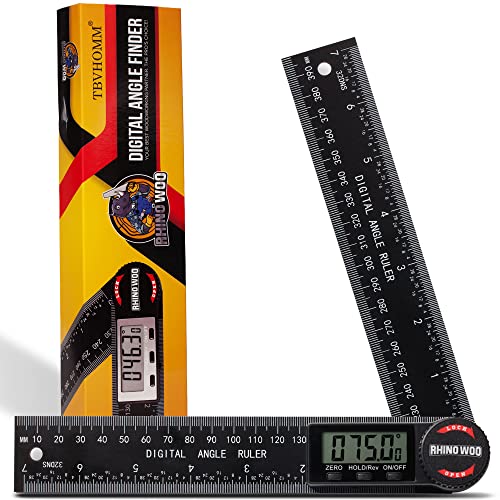
The TBVHOMM Digital Angle Finder Protractor combines a ruler and digital protractor into a single tool that is suitable for woodworking, construction, and DIY projects. It provides a 7-inch (200 mm) scale and a large LCD display for easy reading. The device supports a wide measuring range from 0 to 999.9 degrees with an accuracy of ±0.3 degrees, and ships with two CR2032 batteries for immediate use. Its robust ABS construction makes it a practical choice for fieldwork.
- 7-inch, 0–999.9° range
- Accuracy ±0.3°; 0.1° resolution
- Large LCD display
- Batteries included
Buying Guide
When selecting an angle finder, consider how you will use it, where you will work, and whether you prioritize precision, portability, or features that reduce rework. The following considerations help clarify choices across the five models presented here.
- Accuracy and range: Some tools offer very tight precision (as good as +/-0.2°) but with limited angle ranges, while others cover a broader scope (up to 999.9°) at slightly lower precision. For crown molding and complex piping, tools with wide range and stable readings are advantageous.
- Display readability: A clear display—preferably backlit or with auto-rotation—improves accuracy in dim shops or awkward positions. Large digits minimize misreads when framing or aligning pieces in tight spaces.
- Build quality and materials: Aluminum bodies deliver durability and corrosion resistance for long-term use, while ABS bodies save weight for fieldwork. Magnetic bases enable hands-free work on metal surfaces, increasing efficiency on the job.
- Versatility: If your projects involve many angles, a 3-in-1 tool or a device that handles both inner and outer angles can reduce tool clutter and save time during layout and cut preparation.
- Zeroing and calibration: The ability to zero the tool relative to a reference is crucial for layout work. Check whether zero references persist after power-down or if re-zeroing is needed with each use.
- Power and maintenance: Battery life, auto-off features, and spare batteries affect uptime in the field. Choose instruments with easy battery replacement and straightforward maintenance routines.
- Portability: Size and weight influence ease of transport between job sites. A compact 7-inch model can slip into a tool bag, while larger units may offer more comfortable handling for long sessions.
- Application fit: For metal surfaces, a magnetic base is a real time-saver. For woodworking, direct angle transfer to saws and clear scale readability can reduce setup time and errors.