Best Circular Saw Blades for Fine Finish Cuts
Choosing the right circular saw blade for finish cuts reduces tear-out and yields clean, professional edges on cabinetry, molding, and veneers. The blades below are built to minimize chipping, deliver smooth crosscuts, and stand up to repeated use. From high-tooth count finish blades to carbide-tipped options with anti-stick coatings, these picks cover a range of materials and saws while prioritizing edge quality and durability.
The following table provides a quick-reference view of five highly-rated finish-cut blades, highlighting their teeth, size, and standout traits. It’s followed by in-depth product details to help you decide which blade best fits your projects.
| Brand / Model | Teeth | Size |
|---|---|---|
| CRAFTSMAN CMAS2725140 | 140T | 7-1/4″ |
| WEN BL0760 | 60T | 7-1/4″ |
| Freud Diablo D0760X | 60T | 7-1/4″ |
| Diablo Ultra Finish 7-1/4″ Blade | 60T | 7-1/4″ |
| CRALY 6-1/2″ Ultra Finish | 60T | 6-1/2″ |
Craftsman 140-Tooth Fine Finish Blade

Craftsman CMAS2725140 is designed for finish work on plywood, OSB, and plastics where edge quality matters most. The blade uses a fully-hardened plate to maintain true cuts and prevent wandering, while precision-ground teeth deliver smooth, accurate crosscuts with minimal chipping. Built from heavy-gauge high-carbon steel, this 140-tooth blade emphasizes extended life and consistent performance. The fine kerf assists in producing tight, clean edges, which is particularly valuable for cabinet faces, paneling, and trim work where size tolerances are shown and visible.
Its high-tooth count makes it a strong option for finish work that requires a near-glass edge. For projects involving lightweight composites or veneered plywood, Craftsman’s blade offers predictable results with reduced breakout along the face of the workpiece. When paired with careful feed rate and stable support, you can expect uniform finishing cuts with minimal chatter and clean surfaces ready for coatings or laminates.
Wen 7.25-Inch Ultra Finish Blade

WEN BL0760 delivers professional-grade finish cuts at a budget-friendly price point. It features a 7.25-inch diameter with a 60-tooth carbide design for smooth crosscuts and crisp edges. The blade is coated with a non-abrasive PTFE cool-cut layer that manages heat, reducing burn marks and prolonging blade life on softwoods, plywood, and veneers. An ultra-thin kerf of 1/16 inch minimizes material waste and provides cleaner reveals, making this blade a versatile choice for cabinetry, furniture components, and decorative trim.
The combination of a precise carbide edge and a heat-resistant coating supports consistent performance through long sessions of finish work. For hobbyists and professionals who prioritize clean edges without breaking the bank, the WEN blade offers dependable results in typical shop environments, especially when paired with proper cutting technique and steady feed pressure.
Freud Diablo D0760X Ultra Sharp Finish Blade
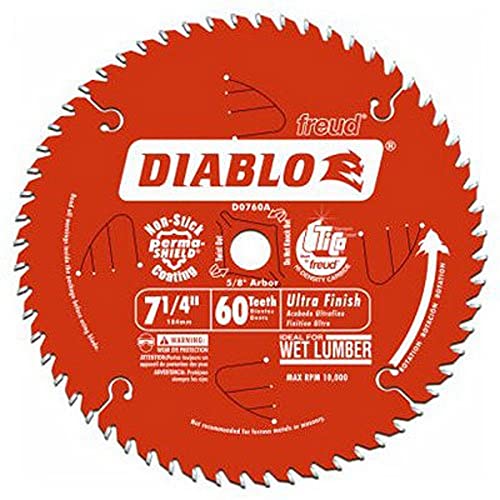
Freud Diablo D0760X is a precision-focused finish blade with an aggressive kerf design that supports accurate cuts and extended blade life. The 60-tooth, 7-1/4-inch blade is optimized for cabinetmaking and fine carpentry where tight tolerances and smooth edges are critical. Stabilizer vents lessen vibration for better control and a more comfortable cut experience. Its Hi-Density special blend carbide provides durability in dense hardwoods and softwoods alike, helping maintain a sharp edge across repeated finish passes.
For projects that demand consistent, tear-out-free surfaces on visible faces, the D0760X delivers reliable performance with minimal breakout along the crosscut edge. When finishing fine moldings or panel transitions, its combination of tooth geometry and carbide hardness helps achieve uniform texture and a refined finish after sanding and sealing.
Diablo Ultra Finish 7-1/4-Inch Blade

Diablo’s Ultra Finish Carbide Saw Blade for Wood is engineered for ultra-finish crosscuts with a 7-1/4-inch diameter and 60 ATB teeth. The blade’s TiCo Hi-Density carbide blend delivers durability and sharpened edges across multiple cuts, while a Perma-SHIELD non-stick coating protects against heat, gumming, and corrosion. A super-thin laser-cut kerf minimizes waste and accelerates finishing, making it well-suited for precise crosscuts and fine edge work on wood, plywood, and melamine surfaces.
This blade excels in applications requiring fast, clean finishes with minimal finishing work beyond sanding. The 5/8-inch arbor adheres to standard saws, offering straightforward compatibility for most mid-range and professional setups. When used with a steady feed and appropriate stock support, it yields consistent edge quality across repeated finish cuts and bevels, helping you achieve ready-to-finish surfaces faster.
CRALY 6-1/2-Inch Ultra Finish Blade

CRALY’s 6-1/2-inch blade offers an ultra-fine finish option with 60 ATB teeth and a 5/8-inch arbor, optimized for clean cuts in plywood, MDF, OSB, and laminated panels. It uses carbide-tipped teeth and a thin kerf design to minimize waste while delivering crisp, smooth edges. A non-stick coating helps reduce heat buildup, and laser-cut expansion slots along with stabilizer vents work together to minimize vibration and maintain cut integrity on sensitive surfaces.
The blade’s robust construction targets long service life on repeated finish cuts, particularly in cabinetry, shelving, and furniture components where precise edge definition matters most. When working with veneered or laminated substrates, CRALY’s design helps resist chipping and tear-out near edge transitions, supporting a high-quality final appearance.
Buying Guide
Blade Size And Arbor Compatibility
Blade diameter must match your saw’s capacity and your project needs. The 7-1/4″ blades are common for standard circular saws, while 6-1/2″ options suit lighter-duty or compact saws. Check the arbor size (commonly 1/2″ or 5/8″) to ensure a secure fit. A mismatched arbor or diameter can prevent installation or compromise cut quality. For finish work on cabinetry and trim, selecting blades with the correct diameter and arbor minimizes swarf, vibration, and runout that can mar edges.
Tooth Count And Geometry
Tooth count strongly influences finish quality and cut speed. Higher tooth counts (60T–140T) yield smoother edges with less tear-out, especially on veneers and plywood. ATB (alternate top bevel) geometry tends to produce cleaner crosscuts in wood products, while a lower tooth count blade is better for rougher cuts. For fine finish cutting, blades in the 60T–140T range are typically preferred, though material type and feed rate also impact results.
Kerf And Coatings
Kerf width affects material waste and cutting speed. Ultra-thin kerf blades minimize material loss and reduce resistance, which is beneficial for high-precision finish work. Coatings such as non-stick (Perma-SHIELD) or PTFE cool-cut layers reduce heat buildup, gum formation, and pitch adhesion, thereby maintaining edge sharpness and prolonging blade life. When finishing delicate edges or operating on laminated surfaces, coatings can noticeably improve performance and consistency across cuts.
Material Compatibility And Finish Quality
Consider the primary materials you work with: plywood, MDF, laminates, melamine, hardwoods, or composites. Some blades are optimized for crosscuts on softwoods and veneered panels, while others excel in hardwoods or dense laminates. Look for carbide formulations designed for finish work, stabilizer vents to reduce vibration, and a geometry that minimizes tear-out on your typical stock. For visible faces, prioritize blades with clean crosscuts and minimal edge fuzz.
Budget, Durability, And Maintenance
High-tooth blades with carbide tips often deliver longer life and consistent finishes, but they can cost more upfront. For frequent finish work, a blade with anti-stick coatings can reduce maintenance and help sustain edge quality over time. Balance your budget with expected usage, surface hardness, and the number of finishes you perform weekly. Proper storage, cleaning after use, and avoiding overheating will also extend blade life and maintain finish integrity.