Best Flush Trim Spiral Router Bits for Clean Edges and Precise Work
Answer: If you need clean, precise flush trimming in wood, laminates, and composites, choose a flush trim router bit with a reliable bearing system and high-performance carbide. This guide highlights top options and who they’re best for, so you can pick the right bit for your project, budget, and router setup.
Summary table of selected products:
- EANOSIC Up Down Compression Flush Trim – 1/4″ shank, nano-coated carbide, dual bottom bearings. Best for versatility on hardwoods and laminates.
- EANOSIC Downcut Flush Trim – 1/4″ shank, blue-nano coated, top bearing. Best for minimizing tear-out on end grains and layered materials.
- Whiteside RFTD2100 Spiral Downcut – 1/4″ shank, 1″ cutting length, double bearing guide. Best for clean downcuts and flush trimming in dense woods.
- Yonico 31204q Ultra-Performance Upcut – 1/4″ shank, 1/2″ diameter, upcut. Best for edge routing and end grain with a mirror finish.
- SHARPRO Compression Flush Trim – 1/4″ shank, bottom bearing, reinforced bearing lock. Best for stability in high-speed or heavy-load work.
EANOSIC Up Down Compression Flush Trim Router Bit

Best for: versatile flush trimming on hardwoods, laminates, and composite surfaces. The bit combines a bottom bearing with dual ball bearings and a 1/4″ shank, delivering consistent edge quality and reduced deflection during cutting. The nano blue coating enhances hardness and heat resistance, helping the edge stay sharp longer.
Why selected: It offers an all-in-one solution for both up-cut and down-cut tasks, reducing tool changes on mixed-material projects. The nano coating supports longevity in demanding shop conditions.
Caution: The coating may wear over extended aggressive use; monitor edge sharpness and re-sharpen or replace as needed. Efficiency depends on proper feed rate and material hardness.
EANOSIC Downcut Flush Trim Router Bit
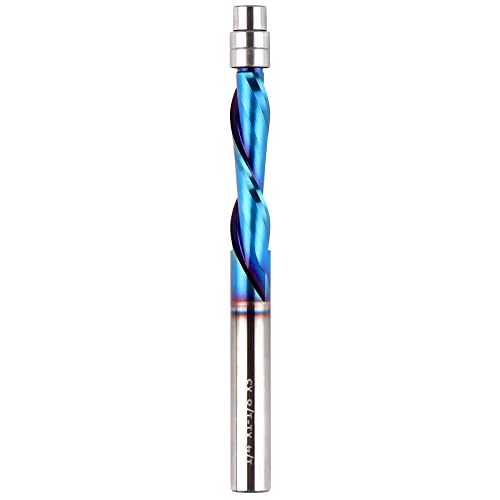
Best for: end-grain precision and clean edge trimming when you’re routing down into the workpiece. The down-cut design helps reduce tear-out on the top surface, particularly with plywood or veneered composites.
Why selected: A durable solid carbide bit with blue nano coating provides good heat resistance and edge retention in heavy-cut scenarios.
Caution: Downcut bits can leave a slightly rougher bottom surface if the cutting length is mismatched to the workpiece; ensure proper depth settings to avoid chatter.
Whiteside RFTD2100 Spiral Downcut Flush Trim

Best for: precise flush trims in hardwoods and laminates with a reliable downcut spiral. The double-bearing guide supports stable, clean edge profiles and reduces deflection at higher speeds.
Why selected: Whiteside is known for consistent geometry and reliable edge quality. This bit excels where a smooth, professional finish is required on a variety of solid and engineered woods.
Caution: Downcut bits can multiply cutting resistance; use appropriate feed rate and allow sufficient clearance to avoid burn or chatter on dense materials.
Yonico 31204q Flush Trim Upcut Bit

Best for: edge routing and finishing with an upcut design to pull chips away from the cut and leave a clean top surface. The solid carbide sleeve with a mirror-finish is designed for precision in pattern routing.
Why selected: The upcut configuration provides strong withdrawal of chips, improving visibility and reducing chip-out on certain materials. The 1/2″ diameter option supports larger trim tasks while maintaining a 1/4″ shank.
Caution: Upcut bits can lift the workpiece if not secured; use clamps or a jig to ensure stability during cut.
SHARPRO Compression Flush Trim Router Bit

Best for: high-speed trimming with stable performance and enhanced safety. The dual bearing system minimizes deflection and supports smoother edge profiling for plywood, laminate, and particleboard.
Why selected: The reinforced bearing lock reduces the risk of bearing ejection, improving safety and workpiece protection during pattern routing and edge trimming tasks.
Caution: Excessively aggressive passes can still cause deflection; prefer multiple light passes for dense materials.
Buying Guide
What is a flush trim router bit and why does bearing matter?
Flush trim bits are designed to reproduce a template or edge by following a bearing mounted at the bit’s tip or top. A reliable bearing system reduces deflection, keeps cuts aligned with the workpiece edge, and helps produce square, clean edges. For most woods, laminates, and composites, a dual bearing setup adds stability during high‑speed routing.
When to choose upcut vs downcut vs compression designs
- Upcut: Best for pulling chips up and away, offering a cleaner top surface and faster material removal. Suitable for edge trimming where tear-out is less of a concern.
- Downcut: Helps minimize tear-out on the top surface, ideal for veneer, plywood, and end-grain scenarios where surface quality is critical.
- Compression (combined up/down behavior): Ideal for plywood and laminates, reducing tear-out on both faces and providing a balanced cut.
Shank size, cutting length, and compatibility
- Most consumer flush trim bits use a 1/4″ shank for common routers; ensure your tool accepts 1/4″ collets.
- Cutting length and overall length affect how deep you can trim in one pass and how much stability you’ll have in the collet.
Coating, material, and durability considerations
Carbide bits with nano or nanocoatings offer greater hardness and heat resistance, extending edge life in demanding jobs. Virgin carbide bits are typically sharp and long-lasting, but proper feed rates and chip control remain essential for longevity.
Safety and maintenance tips
- Secure workpieces with clamps or a jig to minimize movement and vibration.
- Make climb cuts with caution and avoid heavy single-pass cuts on hard materials.
- Inspect the bearing and cutting edge before each use; replace if there is visible wear or looseness.
- Use sharp bits and avoid overheating; dull bits require more force and can cause tear-out.
Frequently asked questions
- What flush trim bit should I choose for plywood? Choose a compression or downcut design with a stable bearing system to minimize tear-out.
- Can I use a flush trim bit for laminate and veneer? Yes, especially compression or downcut bits designed to handle laminate surfaces.
- Do I need a bearing guide? Yes, a good bearing guide ensures consistent trimming along the edge and protects the workpiece.
- What is the advantage of nano-coated carbide? It improves edge retention and heat resistance, extending bit life in busy shops.