Best Foam Spray Insulation for Home Projects
Foam spray insulation offers a fast, reliable way to seal gaps, cracks, and irregular surfaces. It helps reduce drafts, improve energy efficiency, and dampen sound in both new builds and renovations. The following five products represent a range of coverage, expansion, and application options to fit different project sizes and climates. Use the quick-reference table below to compare core specs at a glance.
| Product | Brand | Size / Pack | Notable Feature | Approximate Coverage |
|---|---|---|---|---|
| Beest FullStop Spray Foam Kit | BEEST | 12 cans | High R-value; all-in-one kit | Up to 240 board ft |
| Loctite Tite Foam Big Gaps | Loctite | 12 oz | Fills large gaps up to 3 in | Varies by gap size |
| Loctite Tite Foam Gaps & Cracks | Loctite | 12 oz | Fills gaps up to 1 in; UV resistant | Varies by gap size |
| Great Stuff Wide Spray Foam Kit | Great Stuff | 4 cans | Wide coverage; indoor/outdoor use | Up to 30 ft per can (4 in bead) |
| STANLEY F 990P Supercoat Kit | STANLEY | 12 cans (27.1 oz each) | Monolithic, high-performance seal | Up to 240 sq ft |
The following sections present five carefully chosen products. Each entry includes a concise description, key specifications from the product listing, and practical notes to help decide which kit best fits your project scope.
Beest FullStop Spray Foam Kit
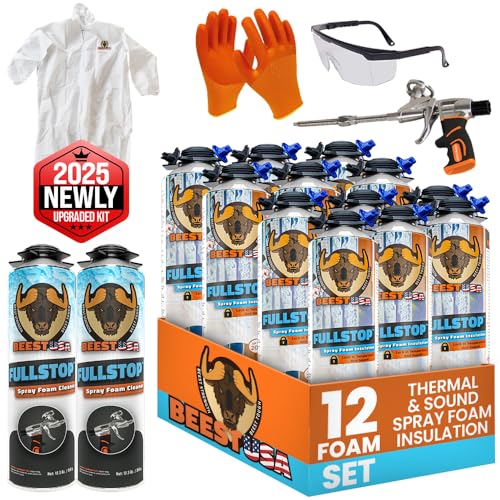
The Beest FullStop DIY Spray Foam Insulation Kit targets both thermal insulation and soundproofing. It claims an R-value of 8.14 when applied at a 2-inch thickness, making it suitable for walls, ceilings, and irregular surfaces where traditional insulation struggles. The kit specifies an ideal working temperature range of 68–77°F, with the foam expanding to seal gaps and cracks and reduce drafts. This is a one-package solution designed for comprehensive projects, including hard-to-reach areas that benefit from a continuous, uniform seal.
Included in the kit are 12 spray foam cans, a heavy-duty gun, a solvent-based cleaner, gloves, goggles, and a coverall, ensuring users have the essential tools without additional purchases. The expansion behavior aims to form a single, continuous seal that resists air infiltration and contributes to year-round comfort. For energy efficiency upgrades, Beest emphasizes easy handling and a blend of performance and convenience.
- Includes: 12 cans, dispensing gun, cleaner, safety gear
- Coverage: up to 240 board feet
- Expansion: seals gaps and cracks consistently
- Optimal application temperature: 68–77°F
Loctite Tite Foam Big Gaps

Loctite Tite Foam Big Gaps is designed to fill large gaps and cracks up to 3 inches wide. This high-density polyurethane foam provides a durable, flexible seal that tolerates building movement without losing adhesion. Its formulation makes it suitable for around door and window frames, plumbing penetrations, and rim joists where expansion and contraction occur. The foam expands to fill voids and forms a robust barrier against air infiltration, moisture, and pests.
The product emphasizes long-lasting performance with resistance to typical weathering, helping maintain the seal over time. It cures to a paintable surface, allowing finishing touches after trimming. For best results, apply in a well-ventilated area and allow adequate curing before finishing. The flexible, high-density foam is especially helpful in larger gaps that standard caulk cannot reliably seal.
- Fills gaps up to 3 inches; high density
- Durable and flexible; resists movement
- Trim and paint after cure
Loctite Tite Foam Gaps & Cracks

Loctite Tite Foam Gaps & Cracks is tailored for smaller openings, expanding to fill gaps and cracks up to 1 inch wide. This product focuses on delivering a tight air seal around outlets, fixtures, and narrow voids, with a strong cell structure for durability. The foam is designed to resist UV exposure, helping maintain performance in exterior or semi-exposed applications, while still providing a closed-cell-like density for insulation benefits.
As a high-density foam, it forms a solid, paintable surface that can be trimmed flush with surrounding material. It is ideal for precisely sealing around pipes, electrical penetrations, and small cavities in basements, crawl spaces, or attic areas. Proper application yields improved energy efficiency and reduced drafts in limited spaces.
- Expands to fill gaps up to 1 inch
- UV resistant; durable
- High-density, paintable finish
Great Stuff Wide Spray Foam Kit

Great Stuff Wide Spray Foam Kit provides a broad-coverage option for sealing larger areas. The kit includes four 18-ounce cans, a range of nozzle options, gloves, and safety glasses, making it a self-contained solution for attic openings, exterior penetrations, and expansive gaps. The foam expands up to one inch, forming a weather-resistant seal that helps reduce drafts and moisture intrusion. This kit emphasizes speed and convenience for quick, large-area applications.
The wide spray capability allows for faster progress on big projects, with nozzle configurations designed to create either a wide bead or more focused spray. Suitable for indoor and outdoor use when ventilation is adequate, it supports DIYers and professionals seeking efficient, scalable insulation, particularly in open spaces and along longer run lines.
- Includes: 4 cans, nozzles, gloves, goggles
- Coverage: up to 30 ft per can (4 in bead)
- Expansion: up to 1 inch
- Indoor/outdoor use with proper ventilation
STANLEY F 990P Supercoat Kit

STANLEY F 990P Supercoat Spray Foam Insulation Kit centers on a reliable polyurethane formula designed for a monolithic, gap-free layer. It covers up to 240 square feet and includes a spray gun, cleaner, and safety items, making it a practical choice for larger projects and retrofit work. The kit’s approach seeks to minimize seams and thermal bridges, contributing to a continuous insulating barrier across walls and spaces where air infiltration would otherwise occur.
The product highlights strong insulation performance with an R-value around 5.66 per inch and a relatively low thermal conductivity of 0.025 W/(m·K). By emphasizing a fast setup and durable, long-lasting results, Stanley positions this kit for professional-grade installations and ambitious DIY renovations requiring a robust, uniform spray foam shell.
- 12 cans, 27.1 oz each; includes gun and cleaner
- R-Value ≈ 5.66 per inch; low thermal conductivity
- Monolithic, continuous insulation
Buying Guide
Choosing the right foam spray kit depends on project size, location, and the level of finish you require. Understanding the tradeoffs between open-cell and closed-cell foams—along with kit contents, cure times, and environmental conditions—helps ensure you select a solution that delivers lasting insulation and reliable air sealing.
Key purchase considerations include: the extent of gaps or cracks, desired R-value per inch, and whether the space is interior, exterior, or exposed to moisture. Closed-cell foams generally provide higher R-values per inch and better moisture resistance, but they form denser structures and may cost more per board foot. Open-cell foams are lighter and more cost-effective for large, porous cavities but offer lower moisture resistance and R-value.
Coverage and packaging are essential for budgeting and scheduling. Some kits advertise board-foot coverage, others square feet per area at a given thickness, and still others emphasize total kit coverage. A multipack with a dispensing gun, cleaners, and protective gear reduces the number of separate purchases. If you’re tackling a large project, a kit with multiple cans and an included gun, like the STANLEY or BEEST options, can boost efficiency and consistency.
Application conditions matter. Most kits perform best within a temperature window (often around 68–77°F) and require ventilation during application. High humidity or extreme temperatures can affect expansion and cure time. Safety gear is essential: gloves, goggles, and a respirator or mask should be used to limit inhalation of fumes during and after spraying. Some products also advise painting over cured foam or applying a sealer to protect exposed foam from UV exposure.
Consider finish and compatibility with your surfaces. Some foams cure to paintable, trim-ready surfaces, and others are designed to be left as is. If the area will be visible or touched frequently, look for a kit that emphasizes paintability and resilience against wear. For exterior applications, UV resistance and moisture performance become critical factors in choosing the right brand and formulation.
In summary, select a kit that aligns with your project scale and environment. For large, continuous seals across walls or attics, a higher-coverage kit with a dependable dispensing system is advantageous. For smaller gaps, a precise, high-density foam with UV resistance can reduce rework. Compare the included accessories, expected cure times, and the recommended operating conditions to estimate total project time and labor when planning your insulation upgrade.