Best Garage Air Filtration Systems for Clean, Dust-Free Workshops
Garages and home workshops generate dust, fumes, and fine particulates from sanding, grinding, and sawing. A reliable air filtration system helps protect lungs, improve visibility, and extend tool life by keeping work surfaces clearer of dust. This guide reviews five garage-focused air filtration options with strong reputations for shop use. Each product is evaluated on airflow capability, filtration setup, installation style, noise, and ease of use. The selections span ceiling-mounted collectors, hanging purifiers, and portable units, offering options for different space sizes and mounting constraints. The table below provides a quick snapshot of the five picks, followed by detailed product sections to help you compare performance aspects and maintenance needs.
| Product | Brand | Airflow (CFM) | Coverage / Notable |
|---|---|---|---|
| WEN 3410 400 CFM Filtration System | WEN | 300/350/400 | Up to 400 sq ft; remote control; replaceable 1-μm and 5-μm filters |
| ALORAIR 360-Degree Intake Filtration System 1350 CFM | ALORAIR | 1350 | 360° intake; ionizer; hanging or bench placement; remote |
| DEWALT DWXAF101 2-Stage Filtration | DEWALT | — | 2-stage: cotton pre-filter + H11 HEPA; remote; auto timer 1–8 hours |
| ALORAIR 360 Degree Woodworking Filtration 1350 CFM | ALORAIR | 1050/1350 | 360° intake; ceiling or bench mount; CA restrictions note |
| Abestorm 1080 CFM Intake Filtration System | Abestorm | 780–1080 | 270° intake; ceiling or wall mount; remote |
WEN 3410 400 CFM Filtration System
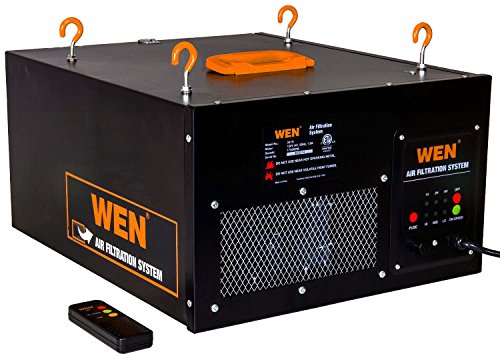
The WEN 3410 provides a compact, portable filtration option suitable for small to midsize garages and workshops. It operates at three speeds, delivering 300, 350, or 400 CFM, which helps match air change rates to the size of the space and the intensity of woodworking tasks. A key feature is its replaceable filtration train: a 1-micron filter paired with a 5-micron pre-filter, designed to capture a wide range of particle sizes from fine dust to larger debris. The unit’s dimensions (approximately 17 inches long, 20.5 inches wide, and 10 inches high) keep it out of the way while maintaining a presence in the airflow path. A programmable timer reduces energy use by shutting the unit off after a user-set period, and a 120V, 60 Hz supply makes it compatible with standard home outlets. The noise rating of 50–60 dB at typical operation is noticeable but manageable in most shop environments. Remote control adds convenience when adjusting settings from the workbench. Overall, the WEN 3410 is well-suited for hobbyists and DIY projects where space is limited but filtration is needed during sanding, finishing, or finishing operations.
Strengths include straightforward filter maintenance, reliable performance at mid-level airflow, and an affordable price point for basic garage filtration. Potential drawbacks are that 400 CFM may be insufficient for larger garages or for spaces with heavy dust loads, and the unit may require placement to optimize airflow in rooms with unusual layouts. For users prioritizing a simple, quiet, and budget-friendly filtration option, the WEN 3410 offers solid baseline performance with practical, user-friendly features.
ALORAIR 360-Degree Intake Filtration System 1350 CFM

This ALORAIR model emphasizes coverage and mobility in a woodshop or garage environment. With a substantial 1350 CFM rating, it is designed to push more air through the filtration train, which helps when the space is larger or when sawdust loads are higher. A built-in ionizer is included, which can help reduce certain odors and improve overall air quality by encouraging particulate charge to settle more quickly. The system can be moved easily using a hook and chain, and it offers both ceiling-hung and bench-placement options, making it flexible for different workshop layouts. A notable note is the California shipping restriction stated in the listing, which means customers in the state should consider alternatives. The timer function allows users to program shutoff between 1 and 9 hours, enabling automatic operation while working late into projects. Overall, this unit is a strong choice for those needing high air throughput with versatility in installation and mobility.
Key advantages include high airflow for large or busy shops, easy relocation via hanging hardware, and a combination of filtration and ionization features that can improve odor control. On the downside, the large size and the California restriction may limit applicability for some buyers. Additionally, the unit’s energy use can be higher at peak settings, so planning for electrical load is advised in larger garages with multiple power-consuming devices running simultaneously.
DEWALT DWXAF101 2-Stage Filtration
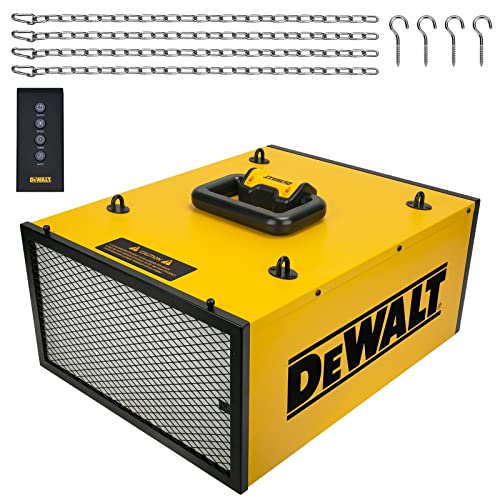
The DEWALT DWXAF101 is designed for users who want a more formal filtration setup with two-stage filtration. The system pairs a coarse cotton pre-filter with an H11 HEPA filter, capable of capturing more than 95% of 0.3-micron particles. This configuration provides noticeably cleaner air in woodworking environments where fine dust and sanding particles are common. The unit includes built-in timer settings for 1, 2, 4, and 8 hours, enabling automatic shutoff after the work period ends. A remote control is included for easy adjustments while working, and the device offers multiple operating modes, including HI, MID, LO, and AUTO, which senses air quality and adjusts accordingly. While the lack of a specified CFM rating makes it harder to compare directly with other units, the two-stage filtration approach and the inclusion of a robust HEPA filter suggest strong performance in dust control for medium-sized shops or garages with moderate dust generation.
Pros include proven filtration performance with a reputable brand, flexible timer options, and remote operation for convenience. Potential downsides include a lack of explicit airflow measurements in the listing, which can complicate room-size matching, and the higher initial filtration cost due to the HEPA element. For buyers prioritizing cleaner air with reliable filtration stages, the DEWALT DWXAF101 provides a credible option for shop environments where precise air quality matters.
ALORAIR 360 Degree Woodworking Filtration 1350 CFM

This ALORAIR unit is tailored for woodworking spaces and other garages where large amounts of sawdust accumulate. It features a 360-degree intake design and a strong vortex fan, delivering a high-volume airflow suitable for covering expansive work areas. The device can operate with two speed settings and includes a timer function to shut down after a chosen period, helping save energy when the space is unoccupied. The model is listed with 1350 CFM and 1700 square feet coverage, making it effective for bigger shops; however, California shipping restrictions apply. The installation options include hanging from the ceiling or placing on a workbench, depending on space configuration. The built-in design focuses on maintaining steady air exchange and improving air quality in busy woodworking environments by capturing dust and fumes produced during cutting, sanding, and finishing operations.
Advantages include broad coverage, flexible mounting, and a high-capacity fan that supports heavy dust loads. Potential considerations involve regulatory restrictions in certain states and the possibility of higher noise at peak operation due to the large fan. This unit suits garages or workshops that require robust filtration across wide areas with multiple active tools.
Abestorm 1080 CFM Intake Filtration System

The Abestorm DecDust 1080 offers a high-capacity solution with a 270-degree three-sided intake design intended to maximize particle capture while maintaining strong airflow (780–1080 CFM). The dual operation modes include both a touch panel and a remote control (with a 26-foot range) for flexible adjustments during work. Quick mounting is supported by included hanging chains and nails, enabling ceiling or wall installation to fit a range of shop layouts. Two-speed adjustment allows lower airflow for quieter operation and higher airflow for heavy dust days. This model is well-suited for garages and woodworking shops where walls and ceilings can accommodate a ceiling-mounted unit or where a portable, ceiling-hung approach is preferred. It’s particularly effective for large particulates and sawdust generation during sanding, cutting, and grinding tasks.
Strengths include strong airflow at maximum settings, flexible mounting, and convenient remote control operation. On the downside, the 26-foot remote range may be insufficient in larger spaces or layouts with obstructions. As with other high-CFM units, energy use and noise can be higher at peak operation. For buyers seeking a ceiling-mounted option that delivers bold filtration performance in a garage setting, Abestorm 1080 CFM provides a compelling balance of power and installability.
Buying Guide
Key purchase considerations
When selecting a garage air filtration system, start by measuring the space you need to treat. Square footage and ceiling height influence the required CFM (cubic feet per minute). A general rule is to target an air exchange rate that completes the room’s volume within 4–6 air changes per hour, but this varies with how dusty the workspace is and how often you work with materials that create fine particles. If you frequently sand or cut, prioritize higher CFM units or multiple filtration stages. If you work in a small, well-sealed garage, lower-CFM units with efficient filtration can still deliver meaningful air quality improvements.
Filtration stages and maintenance
Filtration architecture matters. A typical two-stage setup includes a pre-filter to capture larger debris and a main filter (HEPA or high-grade media) for fine particles. Some models add ionizers to help particulates settle, though ionizers may require additional maintenance and have varying effectiveness depending on room conditions. Replaceability and cost of filters are practical considerations; models with widely available standard filters can reduce long-term costs.
Mounting options and noise levels
Ceiling-mounted units save floor space and can deliver consistent airflow across a workshop. Hanging and bench-mount options offer flexibility for rooms with unique layouts. Noise is an important factor in a garage that doubles as a workspace or a home gym/garage conversion. Look for decibel ratings that fit your tolerance and consider placing filtration units away from work zones or using lower-speed settings during critical tasks.
Energy use, durability, and maintenance
Higher airflow typically means higher energy use and increased wear on motors. Check for energy-efficient features and the availability of replacement filters. Durability matters in a garage setting where dust, humidity, and temperature swings are common. Consider units with robust housings, reliable remote controls, and straightforward maintenance procedures to minimize downtime.
Safety, compliance, and regional considerations
Some filtration systems carry regional restrictions or shipping limitations due to environmental or regulatory rules. If you live in states with specific air quality or equipment restrictions, review the product’s notes before purchasing. Also, verify electrical requirements align with your garage outlets to avoid overloading circuits when multiple tools run simultaneously.
In summary, the best garage air filtration system for your space depends on room size, dust load, and installation preferences—portable, hanging, or ceiling-mounted. For smaller work areas, compact models with 300–400 CFM may suffice, especially when paired with replaceable filters and timers. For larger garages or busy workshops, high-CFM units (1000+ CFM) or multi-stage setups provide stronger filtration and quicker air exchanges. By aligning product specs with your space and workflow, you can achieve cleaner air, better visibility, and a healthier, more efficient garage environment.