Best Household Battery Chargers for Everyday Power
In households, rechargeable batteries cut waste and save money. Modern chargers offer independent slots, smart charging, quick power, and safety features that protect your investments. This guide highlights five top options for NiMH and Ni-Cd packs, including 8-bay and 16-bay models, as well as USB-powered and high-capacity units. Each choice emphasizes versatility, efficiency, and safety to fit busy families, hobbyists, and DIY projects. Use the snapshot below to compare core capabilities at a glance.
| Product | Brand | Key Benefit |
|---|---|---|
| EBL 8-Bay | EBL | Independent 8-slot MCU control |
| POWEROWL 8 Bay | POWEROWL | USB high-speed, independent slots |
| BONAI 16 Bay | BONAI | Mix AA/AAA, LEDs |
| EBL 9V/AA/AAA | EBL | Discharge LCD with safety |
| NOCO GENIUS1 | NOCO | Maintainer and desulfator |
EBL 8-Bay AA/AAA Charger

The EBL AA AAA Battery Charger comes with eight independently controlled slots for NiMH and Ni-Cd cells. Each bay is managed by an onboard MCU that detects input voltage, prevents overcharging, and stops charging when a battery is full or defective. LED indicators show progress: red for charging, green for full, and a flashing red for bad batteries or non-rechargeables. The charger supports 1 to 8 batteries concurrently and is built with fire-proof materials for safety. It accepts an AC plug for wall use and is suitable for daily household recharges.
POWEROWL 8 Bay AA/AAA Charger
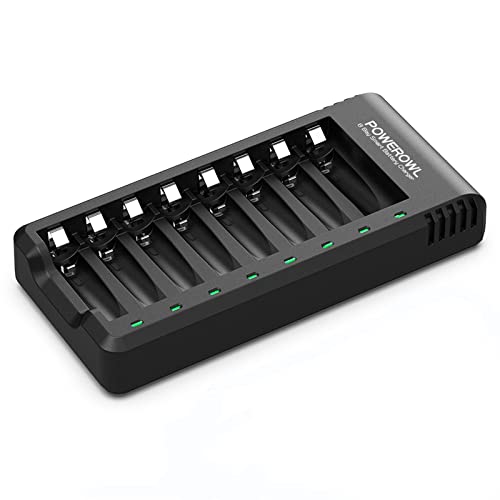
POWEROWL’s 8 Bay AA/AAA Charger delivers high-speed USB charging with independent slots, so you can mix a few AA and AAA batteries at once without using a separate adapter. The charger uses chip-level control to stop charging when the cells reach full capacity, helping extend battery life. LED indicators reveal which ports are active, while its compact design fits on crowded desktops or a kitchen counter. The unit is designed to protect batteries from overheating and short circuits and works with Ni-MH and Ni-Cd cells.
BONAI 16 Bay NiMH/NiCd Charger

BONAI’s 16 Bay AA/AAA Battery Charger offers vast capacity for households with many devices, charging NiMH or NiCd cells in independent slots. Its design supports mixing single, double, and triple battery loads simultaneously, so you don’t need to group batteries in a particular pattern. LED indicators guide status: solid green when full, red when charging, with a cautionary note that it cannot charge alkaline or lithium cells. The charger plugs directly into standard American outlets and maintains safe operation through smart protections, including automatic shutoff when slots are idle or empty.
EBL Smart Battery Charger For C D AA AAA 9V
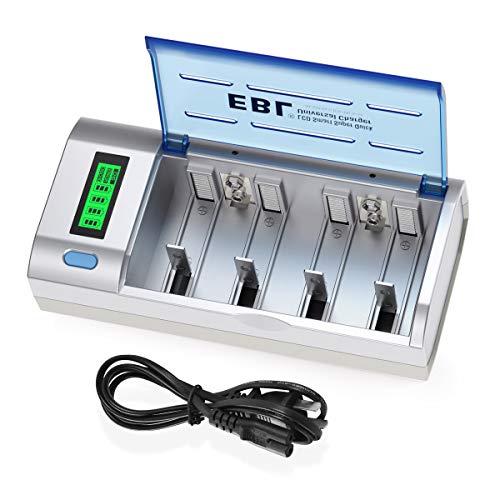
EBL Smart Battery Charger for C D AA AAA 9V Ni-MH/Ni-Cd batteries provides flexible, multi-size charging with four AA/AAA/C/D slots and one to two 9V bays, each on an independent channel. A built-in LCD displays discharge mode and status, and a blue button initiates deliberate battery discharge to restore performance. The unit charges faster by coordinating the total current across active bays, while auto-detection protects against improper input and short circuits. As a safety feature, the charger uses fire-retardant materials and supports safe operation in a typical American plug environment.
NOCO GENIUS1 1A Smart Charger

NOCO GENIUS1 offers a compact, smart charger and maintainer for 6V/12V lead-acid batteries and lithium-ion cells, delivering 1 amp of steady current with automatic maintenance, trickle charging, and a desulfator function. The integrated thermal sensor adjusts the charge based on ambient temperature, preventing overcharge in heat and undercharge in cold environments. This makes it a versatile option for cars, motorcycles, and small power packs. Despite its small size, it features overcharge protection, temperature compensation, and compatibility with a range of battery chemistries, offering a long-term battery health solution.
Buying Guide
Slot architecture and independence
Look for chargers with independent charging channels. Independent slots prevent one battery from affecting others in the same unit, so you can mix different battery chemistries, capacities, and sizes in one session. Chargers that support 4, 8, or 16 bays are ideal for households with many remotes, toys, and flashlights. When possible, verify that each bay has its own charging circuit and protective features, so idle bays don’t draw power or interfere with active ones.
Battery chemistry compatibility
Most home use focuses on NiMH and Ni-Cd cells. Some chargers also support C/D size or 9V packs, and certain models offer Li-ion or lead-acid compatibility. If you own varied devices, choose a charger that lists NiMH/NiCd compatibility and notes any chemistry restrictions (for example, some units cannot charge alkaline or lithium cells). A versatile charger reduces clutter and ensures you can refresh all devices with a single device.
Charging speed and current management
Charging speed depends on total current and how it’s distributed across bays. Units with higher total currents (e.g., 2A or more) can replenish multiple cells faster. USB-powered models can offer convenience and reduced wall-wort usage, while AC-powered units typically provide consistent performance. Some chargers automatically stagger currents or detect full capacity to minimize wear on batteries. Consider your typical daily load and how quickly you want to refresh devices when selecting a model.
Safety features and durability
Safety should be a primary concern. Look for automatic shutoff, voltage and short-circuit protection, and temperature monitoring. Fire-retardant materials add a layer of safety, especially in busy households. A charger with an LCD or LED indicators helps you monitor status at a glance. For high-capacity units, confirm that the construction uses robust materials and includes overload protections to prevent hazards during long charging sessions.
Display, indicators, and ease of use
Displays and LEDs help you quickly assess charge state and fault conditions. LCDs offer more detail (discharge mode, battery health) but may add cost. At a minimum, ensure there are clear LED indicators for charging, full, and fault conditions. A straightforward user interface—easy to insert and remove batteries—saves time, especially when you’re replenishing many devices in short order.
Practical considerations: footprint and price
Consider the physical footprint of the charger in relation to your space. Bigger units with more bays provide future-proofing but require more counter or shelf space. Compare the number of bays, slot independence, and supported chemistries against price. While multi-bay units may have higher upfront costs, they reduce the number of separate chargers you need and can lower long-term battery replacement costs by optimizing charging routines.
Brand reliability and warranties
Choose chargers from established brands with positive reliability histories and robust warranties. Reputable brands typically offer better customer support and longer life spans, which matters when you’re managing power devices across a busy home. Reading user reviews for real-world performance can also help identify any recurring issues with heat, balance, or compatibility.
Quick comparison at a glance
- Bay count: 8, 16, or 1; independent slots improve flexibility.
- Power source: USB, AC, or both; choose based on space and convenience.
- Safety: auto-shutoff, temperature compensation, protection against overcharge.
- Display: LED indicators or LCD provide charging status and diagnostics.
- Maintenance: some models offer discharge functions or desulfation features.
Choosing a charger involves balancing capacity, speed, safety, and space. For households with many remotes, toys, and tools, a high-bay, independently controlled model (like the 8- or 16-bay options) can dramatically simplify recharge routines. If you prefer flexibility with battery sizes or plan to travel with your charger, a compact, USB-enabled unit may be the best fit. Regardless of choice, prioritize safeguards, clear indicators, and compatibility with your current battery types to maximize longevity and performance.