Best Metal Pipe Cutter Tools for Precise, Easy Cuts
Answering the question most buyers have when shopping for metal pipe cutters: which tool delivers clean, straight cuts across common pipe materials and diameters? This guide spotlights five top models, each chosen for reliability, versatility, and clear cutting action. Ideal for plumbers, HVAC pros, and DIY enthusiasts, these cutters cover a range from tiny 1/8 inch tubes to thick-walled 2 inch pipes.
| Product | Best For | Why It Stands Out |
|---|---|---|
| Heavy Duty Tube Cutter, 3/16 to 2″ OD (MECHCLAW) | Versatile ranges; multiple materials | Wide compatibility with a replaceable blade for long-term value |
| RIDGID 101 Close Quarters Tubing Cutter | Tight spaces | Excellent control with knurled screw for precise pressure |
| Ultimate Tube Cutter Set (SEDY) | Professional sets | Six independent bearings for speed and precision |
| TOLESA Pipe Cutter Tool Heavy Duty | All-around cutting plus deburring | Premium alloy with six high-density ball bearings |
| Godora 1–3 Inch Heavy Duty Pipe Cutter | Higher diameter needs | Extra-long handle for greater leverage |
Heavy Duty Tube Cutter, 3/16 to 2″ OD — MECHCLAW

This model covers a broad range: 3/16 to 2 inch outer diameter tubes, suitable for copper, brass, iron, aluminum (wall < 0.12″), and some stainless steel (wall < 0.08″). Best for plumbers and HVAC techs needing one tool for many pipe sizes. The cutter features dual rows of ball bearing rollers to grip the tube for straight, burr-free cuts, reducing rework. It uses an industry-grade replaceable blade for long-term durability. A potential limitation is not designed for tight corners where space is extremely limited. Best for straightforward runs and mid-size to large pipes.
RIDGID 101 Close Quarters Tubing Cutter

Best for tight spaces and small-diameter work. It handles 1/4″ to 1-1/8″ tubing across copper, aluminum, brass, and even some plastics. The knurled feed screw knob lets you control cutting pressure, enabling cleaner cuts in cramped installations. This model excels where space is limited, but its cutting range is narrower than some generic cutters, so avoid it if you regularly work with larger tubes.
Ultimate Tube Cutter Set — 3/16″-2″ OD

Best for professionals needing a comprehensive kit. This set includes a heavy-duty cutter plus a mini cutter (1/8″-7/8″) and a deburring tool. It uses six independent bearings to improve cutting speed and precision, with ultra-sharp, heat-treated steel wheels. Good for varied metals and tubes, though the larger main cutter may be less nimble on very small diameters. Choose this if you want a complete kit with deburring capabilities.
TOLESA Pipe Cutter Tool Heavy Duty 1/8″-2″ with Deburring
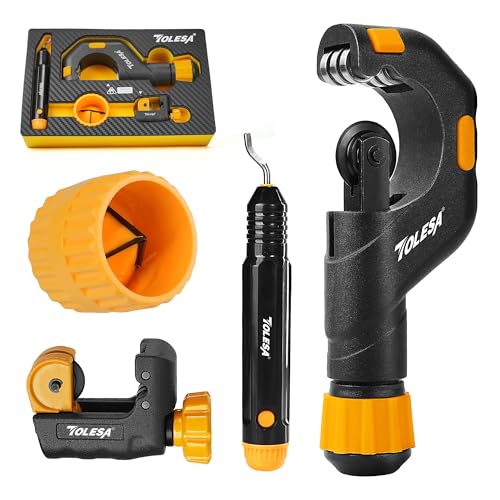
Best for a robust, all-around tool. This cutter uses sharp SKD wheels and six high-density ball bearings for firm grip and precise cuts on copper, stainless steel, and other metals. An easy-to-use knob-and-rotate method suits beginners and pros alike. A limitation is that performance may vary with very hard or very thick-walled materials, so verify pipe material and thickness before use.
Godora 1–3 Inch Heavy Duty Pipe Cutter
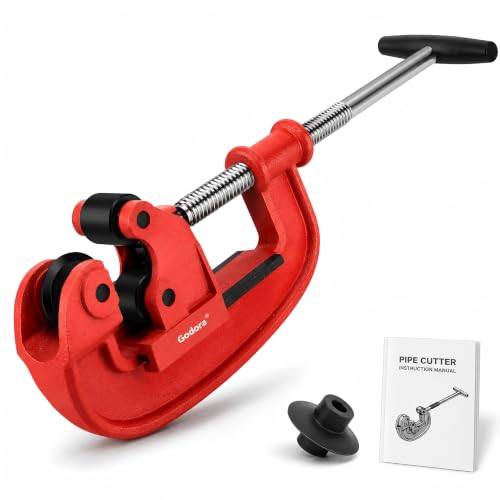
Best for larger diameter needs, this unit handles 1″ to 3″ pipes with a reinforced cutting mechanism and an extra-long handle for leverage. It yields flat, clean, burr-free cuts with a smooth rolling action. Not ideal for all aluminum or copper pipes, so confirm material compatibility. Consider this choice when a longer reach and higher leverage are required for thicker-walled tubes.
Buying Guide: Key Considerations for Metal Pipe Cutters
- Cutting range: Match the tool’s capacity to your typical pipe sizes (e.g., 1/8″ to 2″ or more).
- Material compatibility: Check whether the cutter handles copper, brass, steel, stainless steel, aluminum, and plastics.
- Cut quality: Look for features like ball bearing rollers and sharp wheels for burr-free finishes.
- Leverage and leverage aids: Longer handles and knurled knobs improve control in tight spaces or hard-to-cut materials.
- Blade longevity: Replaceable blades extend tool life and maintain cutting performance.
- Deburring capability: Built-in reamers or separate deburring tools speed up finishing work.
- Portability and weight: Lighter, compact models are better for field work; heavier kits suit shop use.
- Durability: Steel construction and heat-treated components indicate better long-term durability.
Frequently Asked Questions
- What is the typical cutting range I should consider?
- Are replaceable blades worth it?
- Can these cutters handle stainless steel?
- What is the advantage of a close-quarters cutter?
- Should I choose a kit with a deburring tool?
- Is leverage important for thick-walled pipes?
Most professionals need 1/4″ to 1″ cutters for residential plumbing, with some requiring up to 2″ for larger projects. A versatile model covering 3/16″ to 2″ meets many needs.
Yes. They extend tool life and ensure consistent cut quality across many jobs.
Some cutters support stainless steel with appropriate wall thickness limits; verify the exact thickness and material before use.
Close-quarters cutters fit into tight spaces where standard models cannot maneuver, at the cost of a narrower cutting range.
Yes, if you frequently finish cuts, a deburring tool speeds up post-cut work and improves pipe fitment.
Yes. A longer handle provides more leverage, making it easier to apply the needed pressure for clean cuts on robust tubes.