Best Multi Gas Detectors for Professional Use
Multi gas detectors protect workers and households from hazardous gases by delivering real-time readings, audible alarms, and event logging. The market offers many four- and five-gas models with variations in sensors, battery life, data export, and ruggedness. This guide highlights five top models that balance accuracy, durability, and usability for professional environments. The comparison table below helps you quickly assess core specifications, while each product section explains what to expect in practice. All selections are suitable for industrial sites, construction, emergency response, and home safety, with a focus on reliable alarm performance and long-term value.
| Product | Gas Coverage | Power / Battery | Notable Feature |
|---|---|---|---|
| TopTes Guard-863Pro | H2S, CO, LEL, O2 | 18h battery | 5-year O2 sensor; USB data export |
| TopTes Guard-101 | H2S, CO, LEL, O2 | 14h | Triple alarm; rugged; password protection |
| MSA ALTAIR 4X | LEL, O2, CO, H2S | Up to 24h | IP67; rugged; man-down alarm |
| Forsensal 4-Gas With Pump | CO, O2, H2S, LEL | Rechargeable 3000mAh | Built-in pump; calibration kit |
| Forensics FD 4 Gas Monitor | O2, CO, H2S, LEL | Data logging up to 1200 alarms | Color display; USA NIST calibration |
TopTes Guard-863Pro 4-Gas Monitor

The TopTes Guard-863Pro is a compact four-gas monitor designed to deliver reliable detection for H2S, CO, LEL, and O2. It provides a fast 0.5-second response time, helping teams respond quickly to rising threats. An upgraded O2 sensor from DDS (UK) supports a service life of up to five years, reducing maintenance interruptions in demanding environments. This model combines accuracy with longevity, making it well suited for industrial sites and home safety scenarios where dependable gas monitoring matters most.
A vivid TFT color display presents real-time gas concentrations and trend data, enabling quick interpretation even in low-light conditions. The device also offers USB data export for alarm records, fault logs, calibration histories, and operation histories, supporting traceability and compliance. Its triple alarm system—sound, light, and vibration—remains active until gas levels return to safe limits, ensuring no alert is missed during busy work shifts.
TopTes Guard-101 4-Gas Detector
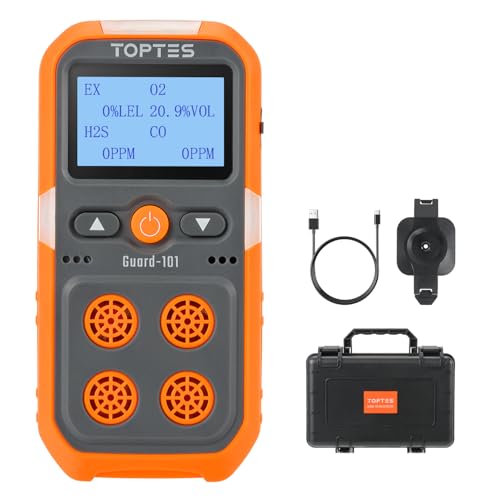
Guard-101 focuses on quick, reliable detection across four gases: H2S, CO, LEL, and O2. It is designed for rapid response, with readings delivered in about 0.5 seconds for timely safety decisions. The device features a robust, water- and dust-protected shell with explosion-proof capabilities, making it suitable for harsh work environments. A back clip allows convenient carrying, and password protection helps prevent accidental operation during busy shifts. Battery life reaches up to 14 hours, supporting longer monitoring periods between charges.
Triple alarm modes—LED, vibration, and audible—ensure alerts are noticeable in loud workplaces. Readings and alarms persist until concentrations return to safe levels, reducing the risk that actions are delayed. The Guard-101 also offers alarm records storage, enabling teams to review incidents and respond more effectively. This model is a strong choice for construction, manufacturing, and maintenance settings where rugged reliability matters.
MSA ALTAIR 4X Multi-Gas Detector
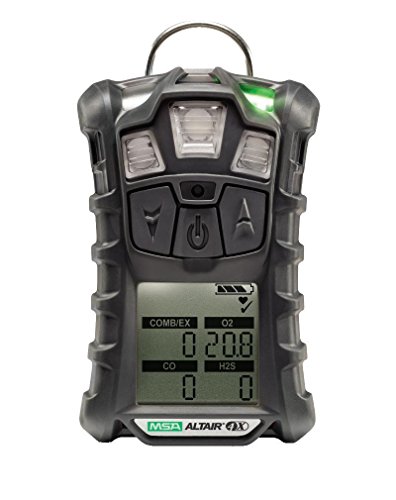
The MSA ALTAIR 4X is a durable four-gas detector engineered for reliability across LEL, O2, CO, and H2S. The device uses a two-tox CO/H2S sensor setup to minimize cross-channel interference and improve measurement accuracy, especially in challenging environments. Its rugged exterior and IP67-rated body withstands dust, water, and rough handling, making it a staple on construction sites, industrial plants, and emergency response operations.
Designed for harsh conditions, the ALTAIR 4X operates in extreme temperatures and features a rugged rubber casing. It includes a man-down alarm and LED indicators, with a battery capable of supporting long shifts—up to 24 hours in typical use. The instrument is built for safety compliance and field service, with straightforward maintenance and durable performance that many professionals rely on daily.
Forsensal 4-Gas Detector With Pump

The Forsensal 4-Gas Detector with Pump integrates four-gas monitoring (CO, O2, H2S, LEL) with an internal pump for rapid sample collection. It ships with a 3000 mAh rechargeable battery and emphasizes long operating life between charges, supporting extended field work. An initial password such as “4321” is provided to prevent unauthorized use, and the device comes with a calibration cap and other accessories to streamline setup and ongoing accuracy.
The large LCD display makes it easy to read gas concentrations at a distance, while the built-in pump delivers samples from tough-to-reach areas. You can view records and gas-type curves with time stamps for post-shift analysis. This unit suits installers, sewer teams, and industrial technicians who require quick sampling, reliable data, and a flexible pumping option for confined spaces.
Forensics FD 4 Gas Monitor
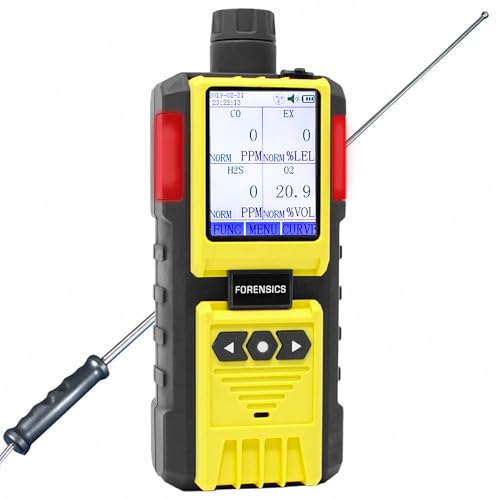
The Forensics FD 4 Gas Monitor provides four-gas coverage—O2, CO, H2S, and LEL—with a color display and graphing capabilities for intuitive operation. It emphasizes USA NIST traceable calibration conducted in Los Angeles, ensuring traceability and measurement credibility. Data logging supports up to 1200 alarm records, aiding incident analysis and compliance documentation. The device employs a built-in pump with a dedicated probe to facilitate efficient sampling in challenging environments.
The color display and graphing features enable quick interpretation of trends during a shift, while the time-stamped records support safety audits and regulatory reporting. This detector is appropriate for chemical plants, industrial facilities, and remediation projects where robust data capture and visualization improve safety outcomes.
Buying Guide
Key purchase considerations
- Gas coverage: Most professional models monitor four gases (O2, CO, H2S, LEL). If your work involves other contaminants, verify sensor availability and cross-sensitivity characteristics.
- Sensor technology: Electrochemical sensors dominate multi-gas detectors for O2, CO, and H2S. Catalytic LEL sensors are common for hydrocarbon detection. Some models use dual-sensor configurations to reduce cross-sensitivity.
- Power and battery life: Choose devices with battery life that fits your shift length. Pump-enabled units generally consume more power, but batteries like 3000 mAh or larger can support longer operations between charges.
- Pump vs diffusion: Pumps speed sample collection in confined spaces or when fast responses are essential. Diffusion-only units are lighter and simpler but may be slower to respond in some scenarios.
- Alarms and notices: Look for multiple alarms (audible, visual, vibrating) and long-lasting alarms during transient gas spikes. Data logs and alarm history enhance post-incident analysis.
- Display and data management: Color LCDs with trend graphs simplify interpretation. USB or Bluetooth data export supports reporting, calibration records, and regulatory compliance.
- Durability and certifications: IP ratings (e.g., IP67) protect against dust and water exposure. Certifications (CSA, UL) and operating temperature ranges ensure suitability for harsh environments.
- Calibration and maintenance: Consider devices with straightforward calibration and documented maintenance procedures. NIST or other calibration traceability can be important for audits.
- Form factor and ergonomics: A compact, lightweight design with a comfortable clip enhances daily use. Some models feature password protection to prevent accidental changes in critical settings.
Use-case oriented guidance
For field technicians who roam hazardous sites, ruggedness, long battery life, and reliable alarms are essential. Pumps are beneficial for sewer lines, confined spaces, or areas with poor air exchange. In environments where data collection and audits are regular requirements, models with USB export, color graphs, and robust calibration options provide clear advantages.
Where space is limited or weight is a concern, lighter diffusion-only detectors with strong alarms can be sufficient for short tasks. Industrial workplaces with frequent inspections benefit from devices with IP ratings, drop resistance, and the ability to store alarm histories. Matching device capabilities to your typical work environment will yield the most value.
Quick feature comparisons
- Best for data and compliance: models with USB data export and alarm record storage.
- Best for confined spaces: detectors with built-in pumps and long battery life.
- Best for rugged, outdoor use: IP-rated, explosion-proof, and wide-temperature-range devices.
- Best for speed: devices with ultra-fast response times and clear trend visualization.