Best Sanders for Furniture: Achieve Smooth Wood Finishes
This guide highlights the best Sanders for furniture finishing, focusing on models with strong dust control, comfortable grips, and efficient material removal. Whether you’re refining tabletops, drawers, or curved legs, these options cover corded and cordless, detail and orbital styles, to help you achieve smooth, shop-quality results. The table below summarizes five strong picks, followed by in-depth product sections to compare power, control, and dust management.
| Product | Brand | Best For | Key Feature |
|---|---|---|---|
| DEWALT DWE6421K | DEWALT | All-around sanding | 12,000 OPM, 3.0 A, low vibration |
| BLACK+DECKER BDEMS600 | BLACK+DECKER | Detail work with dust collector | 3-position grip, includes dust collector |
| SKIL SR211601 | Skil | Large surfaces with dust control | 13,000 OPM, X-flow cyclone dust box |
| SKIL SR250801 | Skil | Tight spaces with sheet changes | 1.0 A, micro-filtration dust port |
| DEWALT DCW210B | DEWALT | Cordless flexibility | Brushless, 8,000–12,000 OPM |
DEWALT 20V MAX Orbital Sander

The DEWALT DCW210B is a cordless option designed for furniture projects where mobility matters. Its brushless motor enhances runtime and efficiency, and its variable-speed control spans 8,000 to 12,000 OPM to adapt to different materials and finishes. The low-profile body helps you reach close to edges and tight spots, making it suitable for table edges, chair legs, and cabinet faces. Battery-powered operation reduces cord clutter in smaller workshops or on-site furniture work.
- Brushless motor for efficiency and longer life
- Variable speed: 8,000–12,000 OPM
- Low-profile for access to tight areas
Skil SR211601 5” Random Orbital Sander

The SKIL SR211601 offers a balance of power and dust management ideal for furniture surfaces. Its 2.8-amp motor delivers 13,000 OPM for efficient material removal across tabletops and large panels. The X-flow dust collector uses cyclone action to capture dust in a transparent container, making it easier to monitor dust buildup and maintain a cleaner work area. The sander also includes variable speed control to adapt to different wood types and finishes.
- 2.8-amp motor at 13,000 OPM
- X-flow cyclone dust container
- Variable speed for material versatility
Skil SR250801 Corded Detail Sander

The SKIL SR250801 is a compact detail sander designed for fine furniture work and tight corners. It features a 1-amp motor delivering up to 12,000 OPM, which is sufficient for finishing tasks and delicate surface smoothing. The dust management system includes a micro-filtration dust port, helping minimize mess during edge work and inside joints. The hook-and-loop sanding sheet changes speed setup, enabling quick transitions between grits while maintaining control.
- 1.0-amp motor, up to 12,000 OPM
- Micro-filtration dust port
- Hook-and-loop sandpaper changes for quick grit swaps
Skil Corded Multi-Function Detail Sander
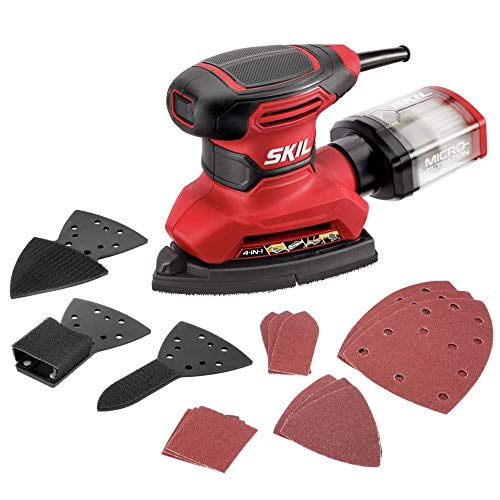
The SKIL SR232301 4-in-1 detail sander is a flexible choice for furniture finishing. It includes multiple detail attachments to reach corners, edges, and irregular contours without changing tools. The 1.2-amp motor provides reliable sandability for fine finishing tasks, and the 1-1/4″ dust port facilitates vacuum attachment to maintain a cleaner workspace. This model is well-suited for trim work, curved legs, and intricate inlays where precise control matters.
- 1.2-amp motor, up to 13,500 OPM
- Three quick-change detail attachments
- 1-1/4″ dust port for vacuum attachment
Buying Guide
Power and speed ranges
Higher OPM means faster material removal but can generate more heat and vibration. For furniture, a sander with adjustable speed or a mid-range range around 8,000–13,000 OPM provides flexibility across softwoods and hardwoods. Cordless options offer convenience for mobile setups, while corded models deliver consistent performance for long finishing sessions. Consider a model with a brushless motor for efficiency and longer life, especially for frequent use.
Sanding pad size and versatility
Five-inch pads are common for furniture panels, tabletops, and cabinet doors, offering a good balance between surface area and control. Detail sanders excel at edges and curves, while random-orbit sanders handle large flat surfaces efficiently. Some models provide multiple attachments for corners and contours, which can reduce tool changes and increase workflow speed on complex furniture pieces.
Dust collection and cleanliness
Efficient dust management improves finish quality and reduces cleanup time. Look for sanders with cyclonic or micro-filtration dust boxes, as well as vacuum ports that match your shop vac. A transparent dust container helps monitor buildup, and a dust bag can be convenient for light-duty work. For finish quality, keep dust out of the finish layer to prevent imperfections.
Ergonomics and control
Comfort matters when finishing furniture. Features like a 3-position grip, soft grip handles, and balanced weight distribution reduce fatigue during long sessions. For curved or detailed work, a lighter sander with a compact profile helps maintain precision without sacrificing control. Noise levels are another consideration; models with vibration reduction and anti-fatigue design help maintain accuracy over time.
Corded vs cordless and value
Corded sanders provide consistent performance and no battery management, making them reliable for workshop use. Cordless models offer mobility and cleaner setups, but run on battery life and change dynamics. Evaluate your typical work environment, whether you move between pieces in a fixed shop or travel to job sites, and choose a model that aligns with your preferred workflow and budget.
In furniture finishing, the best approach often combines a reliable random orbital sander for larger surfaces with a detail sander for tight spaces and contours. A system with a robust dust collection setup will dramatically improve finishing quality and ease of cleanup, enabling smoother, scratch-free results on tabletops, cabinets, and decorative elements.