Best Saw Blades for Ripping: A Practical Guide
Selecting the right saw blade for ripping makes a tangible difference in speed, finish, and material waste. This guide highlights five top 10-inch ripping blades chosen for durable carbide, precise kerf, and stable cuts in softwood and hardwood alike. Whether you’re building cabinets, framing, or undertaking remodel work, the right blade can improve glue-line accuracy and reduce sanding. The overview below provides a quick product snapshot and a buying guide to help you choose the best fit for your shop and saw.
| Product | Brand | Teeth | Kerf | Arbor | Notes |
|---|---|---|---|---|---|
| Diablo D1024X | Diablo | 24 | 0.098″ | 5/8″ | High-performance ripping for wood |
| FOXBC 10-Inch Thin Kerf | FOXBC | 24 | 0.094″ | 5/8″ | Fast, smooth cuts, less vibration |
| Freud LM72R010 | Freud | 24 | 0.126″ | 5/8″ | Rigid, glue-line ready |
| Freud LU87R010 | Freud | 24 | 0.071″ | 5/8″ | Thin kerf for underpowered saws |
| Freud LM74R010 | Freud | 30 | 0.126″ | 5/8″ | Glue-line finishing and durability |
Diablo D1024X 10-Inch Ripping Blade

The Diablo D1024X is built around TiCo Hi-Density carbide engineered for demanding ripping tasks. It delivers clean, glue-ready rip cuts across stock ranging from 3/4″ to 2-3/4″ in wood, plywood, and OSB. A Perma-SHIELD non-stick coating protects the blade from heat, gum, and corrosion, helping maintain edge retention during long jobs and in dusty shops. The blade’s super-thin laser-cut kerf minimizes waste and accelerates feed rates, while a 5/8″ arbor and a maximum 6,000 RPM rating suit many 10″ table saws. This combination makes it a solid choice for remodeling and framing projects.
- TiCo Hi-Density Carbide
- Perma-SHIELD Non-Stick Coating
- Thin Kerf for fast, clean cuts
For performance in varied woods, maintain steady feed and avoid aggressive side-to-side pressure. Regular cleaning helps preserve the coating and prevent pitch buildup, ensuring consistent cuts through hardwoods and sheet goods alike.
FOXBC 10-Inch Thin Kerf Ripping Blade

The FOXBC 10-Inch Thin Kerf Rip Blade is designed for speed and efficiency, featuring 24 FTG teeth and a thin kerf of 0.094 inches. Its 5/8″ arbor matches most standard table saws, and the plate thickness of 0.071″ enhances rigidity while keeping the kerf light for reduced power draw. With a 20° hook angle, this blade minimizes noise and vibration while preserving a smooth finish. Its construction emphasizes toughness, with high-density tungsten carbide ensuring longer life in demanding ripping tasks.
- FTG Ground Teeth
- Kerf 0.094″ and Plate 0.071″
- 20° Hook Angle
Ideal for rapid, straight ripping through softwood and plywood, the FOXBC blade balances speed and finish. For best results, feed steadily and avoid forcing the blade, especially in denser hardwoods where a slower feed can improve edge quality.
Freud LM72R010 Heavy-Duty Rip Blade

Freud’s LM72R010 combines a heavy-duty design with a premium TiCo Hi-Density carbide ripping blend. It’s engineered for fast, smooth rip cuts in both hardwoods and softwoods, with accuracy that supports glue-line edges and minimal sanding. The blade features a rigid body and extra-large flat teeth that help deliver true cuts and stable performance on stock from 3/4″ to 2-3/4″ thick. The 0.126″ kerf provides robust material removal, while the 5/8″ arbor ensures compatibility with most 10″ table saws.
- Rigid body for stability
- TiCo Hi-Density Carbide
- Extra Large Flat Teeth
For high-volume ripping, keep a steady feed rate and ensure the saw’s arbor is properly tightened. When working with hardwoods, a slower approach can reduce tear-out and yield cleaner glue-ready faces with less post-cut work.
Freud LU87R010 Thin Kerf Rip Blade

Designed for underpowered saws, the Freud LU87R010 emphasizes thin-kerf efficiency with a 0.071″ plate and a 0.098″ kerf. The 24 teeth and flat grind are optimized for smooth, straight rip cuts with less horsepower. The thin kerf reduces resistance, enabling quicker feeds while maintaining edge integrity. This blade pairs well with portable or smaller-shop saws where power is at a premium but finish quality remains important.
- Thin Kerf Efficiency
- Flat Grind with TiCo Carbide
- Perfect for Low-Power Saws
When used with a robust feed rate and stable router table or stand setup, LU87R010 can deliver true edges with minimal scorching on hardwoods. Regular cleaning and inspection of the edge will help maintain cut quality over time.
Freud LM74R010 Glue Line Rip Blade
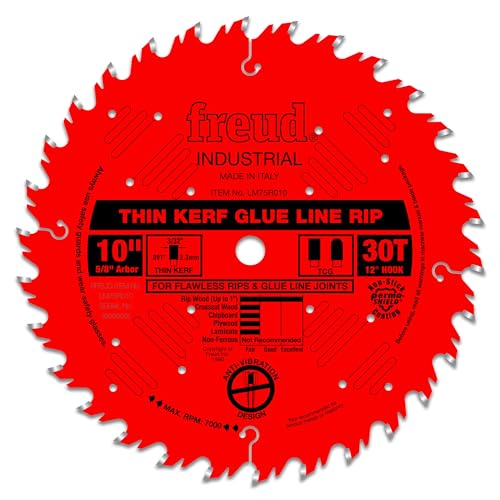
The Freud LM74R010 is built for glue-line craftsmanship, offering a 10″ diameter blade with 30 teeth and a Triple Chip Tooth Grind (TCG). The heavy-duty construction features a thick kerf and reinforced plate to maintain flatness under demanding cutting conditions. The TiCo Hi-Density Carbide blend provides durable, consistent performance through tough woods, while the 0.126″ kerf supports efficient material removal. This blade excels at producing glue-ready edges and smooth surfaces suitable for fine finish work without extensive sanding.
- Triple Chip Tooth Design
- 30 Teeth for smooth, true surfaces
- Glue-Line Ready Finish
For cabinetry and trim work, LM74R010 helps achieve precise rip cuts with clean edges that reduce the need for jointing or sanding. Regular maintenance and proper blade alignment ensure consistent results across repeated cuts.
Buying Guide
Key factors to consider
When choosing a ripping blade, consider blade geometry (kerf width, plate thickness), tooth design, and carbide quality. A thinner kerf generally requires less power and yields faster feeds, but may wear faster on tough hardwoods. A thicker kerf removes more material per pass but can improve stability on very dense stock. Carbide density (Hi-Density TiCo, for example) influences edge retention and resilience against heat buildup during aggressive ripping.
Power, arbor, and compatibility
Match blade kerf and plate thickness to your saw’s motor power and blade speed. For underpowered saws, a thin kerf blade (like LU87R010) helps maintain cutting efficiency. Always verify arbor size (commonly 5/8″) and ensure the blade height and insert clearance allow full tooth engagement without rubbing. A well-maintained machine—clean bearings, true alignment, and sharp blades—reduces vibration and improves edge quality.
Tooth count and finish considerations
More teeth typically yield smoother finishes but slower cutting, while fewer teeth rip faster but may roughen edges. For glue-line work or finish-sensitive cabinetry, blades with a true-cut design and flat teeth (as seen in several Freud models) can reduce sanding needs. If finishing is less critical, a 24-tooth blade with a robust carbide blend often balances speed with acceptable edge quality.
Maintenance and safety
Keep blades clean to prevent pitch buildup and heat buildup during long ripping sessions. Inspect teeth for chips and ensure teeth remain sharp and evenly ground. Follow manufacturer safety guidelines, use appropriate push sticks, and maintain a clean work zone to prevent kickback and accidents.