Best Bench Vise for Your Workbench
A dependable bench vise is a cornerstone of a productive workshop. From woodworking to metalworking, choosing the right vise improves accuracy, safety, and efficiency. This guide spotlights five top-rated options that balance strength, versatility, and ease of installation for American hobbyists and professionals alike.
Below you’ll find a concise product summary table, followed by in-depth sections for each selected vise. Each entry highlights core specs, standout features, and practical use cases to help you pick the best fit for your bench.
| Product | Brand | Jaw Width | Opening | Notable Feature |
|---|---|---|---|---|
| VEVOR Bench Vise | VEVOR | 6 in | 5.9 in | 2.9 x 3 in anvil; ductile iron; rust-proof finish |
| IQ Vise (WORK IQ TOOLS) | WORK IQ TOOLS | Varies | Varies | 360° articulation; 8-position locking ball & socket |
| PONY 4-Inch Bench Vise | PONY | 4 in | Varies | 4400 lbs clamping; 360° rotatable base |
| WORKPRO 4-1/2-Inch Bench Vise | WORKPRO | 4.5 in | Varies | Multi-Jaw design for flat materials and pipes |
| HFS 7-Inch Woodworking Vise | HFS | 7 in | Varies | All-iron construction; chrome-plated guide rod |
VEVOR 6-Inch Bench Vise

The VEVOR 6-Inch Bench Vise is designed for demanding tasks in drilling, pipe cutting, and metalworking. Its 360-degree swivel base allows precise orientation, while the robust platform provides a stable clamp for larger pieces. The 6-inch jaw width accommodates bigger workpieces, and the 5.9-inch opening enables a wide range of clamping options. An integrated 2.9″ x 3″ anvil adds a secondary working surface for quick shaping or flattening tasks, boosting overall utility in a single tool.
- Jaw Width: 6″, Opening: 5.9″, Throat: 3.5″
- Clamping Force: Up to 4,496 lbs (20 kN)
- Material: 60,000 PSI ductile iron with rust-proof powder coating
- Replaceable serrated jaw plates (premium carbon steel)
- Included hardware: nuts, screws, manual, magnetic jaw pads; easy setup
Durability and installation are prioritized in this model. The ductile iron body combines strength with resilience, while the powder-coated finish resists corrosion in busy shop environments. The included installation kit means less to purchase separately, enabling quick setup on a wooden or metal bench. The replaceable jaw plates help extend service life when you tackle tough, repetitive gripping tasks. For users handling heavy stock or demanding manufacturing projects, the VEVOR vise offers a compact, reliable solution with room to grow.
IQ Vise 360° Articulating Bench Vise

The IQ Vise from WORK IQ TOOLS adds versatile articulation to a compact bench vise. Its construction blends hardened steel with cast aluminum, providing strength while keeping weight manageable for portable setups. The 360-degree movement enables nearly unlimited positioning, and the eight-position locking ball-and-socket mechanism ensures secure angles for intricate woodwork or stubborn pipe work. The Quick Cam feature allows fast locking and unlocking at any angle, improving workflow when frequent repositioning is required.
- Construction: Hardened steel with cast aluminum
- Articulation: 360° movement
- Locking: 8-position ball-and-socket
- Torque capability: Up to 130 ft-lbs
- Locking system: Quick Cam for rapid adjustments
Best suited for projects requiring precise angles and repeatable positioning, the IQ Vise excels in detailed woodworking, metalworking, and pipe fitting where conventional fixed vises may slow progress. While the model emphasizes versatility over sheer bite, the robust materials and articulation empower users to tackle complex clamping tasks with confidence. The trade-off tends to be a slightly higher price than basic fixed vises, offset by improved positioning flexibility and ergonomic operation.
PONY 4-Inch Heavy Duty Bench Vise
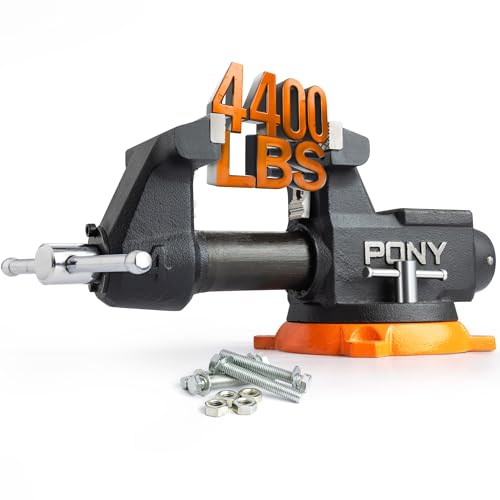
The PONY 4-Inch Bench Vise delivers robust clamping with up to 4400 pounds of force. A 360-degree rotatable base adds flexibility for complex assemblies, while a dustproof rear design helps protect internal components from debris, extending service life in dusty shops. The vise features a smooth operation with a replaceable U-shaped steel part to support long-term durability. This model strikes a balance between compact size and strong holding power, making it suitable for dense woodworking and metalworking tasks on a busy workbench.
- Clamping force: up to 4,400 lbs
- Jaw width: 4″
- 360° rotatable base
- Dustproof rear design; smooth operation
- Replaceable U-shaped steel component
With a mid-range footprint, the PONY vise is ideal for users who need substantial clamping without overwhelming bench space. It handles a variety of tasks—from woodworking to pipe work—while maintaining smooth operation and straightforward maintenance. The 360° base supports precise alignment, and the durable construction promises lasting performance in home shops and professional garages alike.
WORKPRO 4-1/2-Inch Bench Vise

The WORKPRO 4-1/2-Inch Bench Vise is designed for versatility in a compact footprint. Its multi-jaw function lets you clamp flat stock and pipes or tubes securely, reducing the risk of slipping or scratching delicate surfaces. Built from industrial gray iron, this vise offers dependable strength for everyday shop tasks, from home repairs to small-scale fabrication. It’s engineered for easy installation and a stable base, making it a practical choice for hobbyists and professionals who value flexibility.
- Jaw width: 4.5″, heavy-duty gray iron construction
- Multi-Jaw design for clamping flats and pipes
- Easy to install with a stable base
- Suitable for woodworking, welding, drilling, and light milling
For projects that demand quick changes and varied clamping needs, the WORKPRO vise provides an accessible option that doesn’t compromise build quality. Its multi-jaw approach helps users avoid swapping accessories mid-task, improving efficiency in small to mid-sized workshops. While it may be outmatched by larger vises on very thick stock, its balance of capacity and adaptability makes it a solid all-around tool for everyday use.
HFS Woodworking Bench Vise

The HFS Woodworking Bench Vise emphasizes a sturdy all-iron structure with a chrome-plated guide rod for smooth operation and longevity. The 7-inch guide rod design enhances rigidity and accuracy, helping keep workpieces steady during lengthy tasks. A chrome-plated or plated surface adds corrosion resistance, making it a reliable choice for woodworking and light metalworking. Quick installation on a workbench is supported by a solid mounting system and durable construction.
- All-iron construction with protective coating
- Chrome-plated guide rod for durability and smooth operation
- 7-inch guide rod length improves stability
- Easy, quick mounting on standard workbenches
HFS’s design prioritizes strength and reliability for woodworkers needing a long-lasting, fixed vise. While its heavy build is excellent for stationary setups, it may be less portable than articulating models. The 7-inch guide rod provides added leverage and precision, making it well-suited for tasks requiring consistent clamping pressure and minimal flex in the jaw area.
Buying Guide
What jaw size and opening will you actually use?
Jaw width directly affects how large a workpiece you can clamp. Larger jaws (6 inches and up) handle thicker boards or wider metal stock but require more bench space. If most tasks involve thin stock or small components, a 4.5-inch jaw often balances clamping force with space efficiency. Consider your typical material thickness, the number of items you clamp simultaneously, and the depth you need to reach into crowded work areas.
Material, build quality, and durability
Vises fall mainly into cast iron, gray iron, ductile iron, and steel. Ductile iron, as used in several models here, offers higher impact resistance and longevity under heavy loads. Steel components can provide excellent strength with lighter weight. A powder-coated or painted finish helps resist rust in busy garages. Replaceable jaws and threaded components extend service life when grinds, swarf, or corrosion shorten tool life.
Base rotation, alignment, and anvil needs
360-degree swivels add flexibility, enabling precise clamping at odd angles and convenient tool orientation. Some vises include a small anvil surface for quick shaping tasks, while others rely on separate anvil blocks. If your workflow includes frequent orientation changes, prioritize models with a locking swivel base or a robust ball-and-socket articulation system. For metalworkers or fabricators, a built-in anvil can save time and reduce accessory clutter.
Mounting options and installation
Most bench vises bolt directly to the workbench. Some also offer clamping features that can attach to the bench edge without permanent mounting. Check included hardware and the ease of installation—quick-install kits and magnetic jaw pads are a plus for faster setup. Ensure the bench surface thickness you have matches the vise’s mounting clamps or bolt pattern. A secure base is essential to prevent wobble under heavy clamping.
Special features and value considerations
Look for articulating or swiveling capabilities if your projects demand dynamic angles, or multi-jaw configurations that reduce accessory swapping. Quick-lock features, torque tolerance, and integrated dust protection all contribute to long-term reliability. Compare the total cost of ownership, including potential accessories such as replacement jaws, jaw pads, and mounting hardware, to determine which model delivers the best long-term value for your shop.
How to choose among the featured models
For the heaviest, most demanding tasks, a 6-inch or larger vise with a 360-degree base (like VEVOR or PONY) provides robust clamping power and orientation. If you require frequent angle changes and precise positioning, the IQ Vise’s 360-degree articulation offers clear advantages. Where space is limited, a 4.5-inch or 4-inch model with a dependable base (such as WORKPRO) may deliver the best balance between capacity and footprint. For dedicated woodworking with durable guide mechanics, HFS’s 7-inch setup can be compelling, especially with the all-iron construction that resists wear over time.
In short, match jaw size to the typical workpiece, prioritize base stability and durability, and consider whether you need articulation or a larger clamping range. The five models covered here span big and small, fixed and flexible, to help you optimize bench space while maximizing grip and precision on your projects.