Flat Pack Vintage may earn a commission on qualifying purchases through the Amazon links in this article. Confirm the exact model and package before ordering.
The best measuring tool for secondhand furniture depends on the question you need to answer. Overall width, a local corner, and the shape of a molding are different kinds of information, so one attractive tool rarely replaces the others.
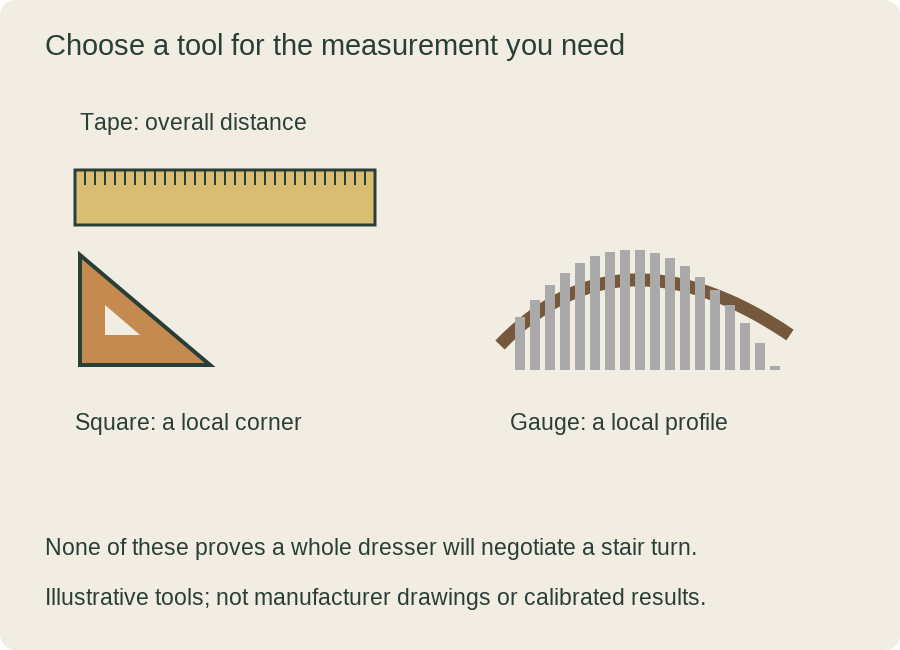
This shortlist compares the Stanley 33-425 PowerLock tape, Swanson T0118 Speedlite square, and General Tools 833 contour gauge by documented purpose. There is no calibration trial, accuracy ranking, or claim that these three tools prove a dresser will fit through your staircase.
Write the measurement question first
Start with a sentence such as “What is the maximum depth, including the handles?” That tells you where the endpoints belong and prevents you from returning home with a precise number for the wrong part of the furniture.
For a room fit, distinguish the closed footprint from door or drawer travel and the space you need to use it. For a delivery route, record the openings, turns, projections, and handling constraints separately.
For a fitting or repair question, identify whether you need distance, a corner relationship, or a profile comparison. A tool that copies an outline does not necessarily give you the numerical dimension or thread specification required to order a replacement.
Keep unknowns visible on your worksheet and record units beside each number. A guessed dimension does not become verified simply because it sits beside measurements taken with a good-quality tool.


Stanley 33-425 PowerLock: for the overall measurement list
The exact Amazon listing identifies a one-inch by twenty-five-foot PowerLock rule with a chrome-colored ABS case. An archived Stanley catalog identifies 33-425 with the same nominal blade length and width; confirm the current US package before ordering.
A retractable tape is the first choice here when you need a dresser’s maximum width, height, and depth or the room’s relevant distances. It serves the broadest buying worksheet without pretending to measure every specialized fitting.
Choose clear endpoints and keep the blade aligned with the dimension you are recording. An angled or sagging path gives you a different distance from the straight maximum envelope you intended to establish.
Read and record the number while you can see both reference points, then repeat important dimensions. A second reading can catch a transcription or endpoint error without turning a casual buying visit into a claimed calibrated inspection.
 Check Price on AmazonStanley 33-425 · 1-inch × 25-foot PowerLock
Follow the tool’s directions for handling the blade and controlling retraction. Do not let the blade snap back toward your hand or somebody else’s face while concentrating on a seller’s explanation.
The limitation is the whole moving problem: tape measurements inform it, but do not prove that a bulky piece can rotate through a landing. Arrange appropriate delivery assessment when a route is close, complex, or dependent on an uncertain disassembly.
Swanson T0118 Speedlite square: for a local corner reference
Swanson identifies the T0118 as an eight-inch Speedlite square made from a high-impact structural composite, in orange. Its right-angle form gives you a local reference that differs from the tape’s long-distance job.
Consider it when you need to compare an accessible corner or communicate the direction of a measured edge. Keep the reference surfaces clean and seat the tool against the intended sound contact, not a decorative molding or a damaged projection.
A local gap can tell you that the surfaces and reference do not meet as expected, but it does not identify the cause by itself. Finish buildup, debris, a rounded edge, local damage, or the furniture’s intended shape can affect what you see.
Do not use one accessible corner to certify the entire drawer, case, or room as square. Measurements and observations need to address the actual structure and mechanism before you draw a broader conclusion.
 Check Price on AmazonSwanson T0118 · 8-inch Speedlite, orange
Its eight-inch format can be useful for the particular accessible area, yet too large or too small for another recess. Check the geometry you need to reach rather than choosing a square on the assumption that larger always improves the assessment.
The limitation is purpose: it cannot replace a tape for the delivery route or establish the center-to-center spacing of hidden hardware automatically. Buy it for a clear local-reference task, or use an appropriate tool you already own.
General Tools 833: for a profile you need to compare
The General Tools 833 is the ten-inch plastic contour gauge, with movable pins that form an impression of an accessible profile. The manufacturer’s catalog page describes copying curved and irregular shapes rather than measuring a whole furniture envelope.
Consider it when the useful question concerns the outline of a molding or another sound, accessible detail. The captured profile can help you explain the shape to a supplier without pretending that a photograph shows its cross-section accurately.
Check that the exact product’s pin travel and usable length suit the feature you need to record. A ten-inch nominal length does not establish unlimited profile depth or guarantee that the body clears surrounding trim.
Use it only where its contact and operating pressure are appropriate to the identified surface. Do not press pins into fragile ornament, loose veneer, flaking finish, or soft material simply because the tool itself is plastic.
 Check Price on AmazonGeneral Tools 833 · 10-inch plastic contour gauge
A profile impression is a temporary reference, so preserve it by the method the product directions support and record what it represents. If the pins shift before the supplier sees them, the shape no longer describes the original feature reliably.
The limitation is that copying a profile does not identify wood species, establish historic accuracy, or prove a replacement fits its full connection. Treat the outline as one part of a larger identification request.
Use the tools as a small measurement system
For a used dresser visit, begin with the tape and the list of maximum dimensions. Add the square only if you have a specific accessible corner question, and bring the contour gauge only when a particular profile matters to the decision.
Photograph your reference points where appropriate and write down whether a number came from direct measurement or the seller. A clear record helps you resolve a conflict later without treating every spoken number as equally certain.
Measure the intended room and delivery route independently rather than relying on a seller’s assurance that the piece “fits most doors.” Room & Board’s guide distinguishes doorway and hall measurements, stair and elevator details, and architectural projections along the path.
Where a moving decision depends on removing legs, mirrors, or another section, confirm the exact method and permission. None of these measuring tools supplies an assembly instruction that the furniture itself is missing.
Make a modest buying decision
Choose the PowerLock when overall distance is the missing capability, the T0118 when a local corner reference serves a real question, and the 833 when you need a compatible profile-copying tool. They are complementary conditional choices, not a first-to-third performance ranking.
Check exact models and selected variants against the current listing before purchase, including the units you need to read comfortably. This review does not convert a regional manufacturer specification into a US warranty or certification promise.
If you already own a sound appropriate tape and only need three exterior dimensions, use it before expanding your kit. Better endpoints, repeated readings, and a clearer worksheet may solve the buying problem more effectively than another gadget.
Keep the final measurement sheet with the listing and compare it with the actual piece at collection. Your useful outcome is a set of traceable answers about the furniture, plus an honest list of the questions these tools cannot settle.
Agree on units with the other person
When you request a measurement, name the units and endpoints in the same message. “Maximum depth in inches, including the handle” gives the seller a clearer task than a vague request for size and makes their answer easier to compare with your room worksheet.
If a result seems inconsistent with the other dimensions, ask for clarification rather than silently correcting it. The apparent mistake may be a different reference point, a missing unit, or a different component.
Sources & editorial notes
Research checked October 22, 2026. Practical examples are editorial explanations; no personal restoration experience or product testing is claimed.
- Manufacturer-authored archived catalog hosted by distributor, exact33-425 table nominal25ft×1in only; current package checked separately on Amazon, no current warranty claim.
- T0118 orange eight-inch composite square; no non-marring guarantee adopted.
- Manufacturer-authored model833 page hosted by distributor: ten-inch plastic movable-pin profile gauge. No exact current calibration/performance claim.
- Whole delivery route requires independent entry/turn/stair/elevator measurements.
- Exact selected listing identity and documented package/floor role or grade; purchase link and primary remote image inspected. No seller rating, price, capacity or tested performance adopted.
- Exact selected listing identity and documented package/floor role or grade; purchase link and primary remote image inspected. No seller rating, price, capacity or tested performance adopted.
- Exact selected listing identity and documented package/floor role or grade; purchase link and primary remote image inspected. No seller rating, price, capacity or tested performance adopted.
Your next useful step
01 / How to Measure a Secondhand Furniture Piece for Your Room and Doorway →02 / How to Compare Furniture Listings When Dimensions Are Incomplete →03 / How to Plan Furniture Layout with Painter’s Tape →